Ouve este podcast gratuitamente na aplicação: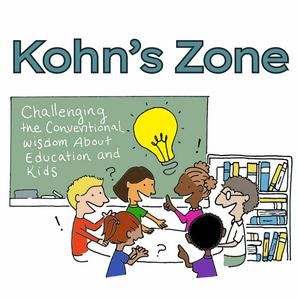 Descarrega gratuitamente na App Store
radio.pt
Sleeptimer
Guardar rádio
Episódios Disponíveis
5 de 13
- Who Gets to Decide?December 15, 2025 Who Gets to Decide? An impressive body of research shows that people of all ages - including students in classrooms - are happier, healthier, and more productive when they have some say about what they're doing. Indeed, the way children learn to make good decisions is by making decisions. Why, then, are so many classrooms more focused on eliciting their compliance than supporting their autonomy? In this, the first of a two-part episode, stories and studies illustrate the benefits of giving students a real voice about what and how they learn, how problems are solved, and even how the classroom is arranged and decorated. What's more, many such decisions are best made collectively (and not just through voting) because autonomy + community = democracy. A note from Alfie Kohn: I made two decisions when I started this podcast. The first was not to accept ads. The second was to avoid putting certain episodes behind a paywall (or offering special content only to those who pay). But this means that I depend on the generosity of everyone who listens to help cover the production costs. So: Can you afford a modest contribution -- ideally on a regular basis, since a podcast, after all, is not a one-shot event? If so, I'd be grateful if you'd support the project with whatever amount seems fair to you. Also, if you enjoy the podcast, please tell other people about it. And if you have feedback about an episode you've just listened to, send it to https://www.alfiekohn.org/contact-us/. Please click the button below to donate. If you don’t see a button, please go to this page (https://coff.ee/kohnszone). Donate PRODUCTION SUPPORT: Ultraviolet Audio ART: Abi Kohn--------20:45
- The Curious Case of the Incurious ChildrenDecember 1, 2025 The Curious Case of the Incurious Children A Conversation with Susan Engel Everyone agrees that it's good to be curious, but that doesn't mean schools are committed to fostering children's curiosity. This extended episode of Kohn's Zone features a provocative conversation with early-childhood expert Susan Engel of Williams College, who draws on a deep background of theory and research (some of it her own) to probe the nature of curiosity -- that remarkable desire we have to resolve discrepancies between what we encounter and what we expected. Curiosity can feed on itself, generating new and subtler questions, yet classrooms often fail to support this process -- and indeed may actively discourage it. The more densely packed the curriculum, and the more structured (and goal-oriented) the school day is, Engel argues, the less chance kids have to wonder and explore. She offers suggestions for how teachers can encourage students' curiosity and help them figure out how best to act on it. We also discuss her newest book, which describes her visists to kindergartens across the country: What distinguishes classrooms for young children that are exceptional from those that make a thoughtful observer wince? (Hint: It's not mostly a function of race, class, or how nice the teacher is.) RESOURCES: Susan Engel, The Hungry Mind (Harvard Univ. Press, 2018) [https://www.hup.harvard.edu/books/9780674984110] Susan Engel, The Intellectual Lives of Children (Harvard Univ. Press, 2022) [https://www.hup.harvard.edu/books/9780674278646] Susan Engel, The End of the Rainbow (New Press, 2015) [https://thenewpress.org/books/the-end-of-the-rainbow/] Susan Engel, American Kindergarten (Univ. of Chicago Press, 2026) [https://press.uchicago.edu/ucp/books/book/chicago/A/bo258923309.html] Alfie Kohn, "Less and Less Curious," Education Week, October 2, 2024 [https://www.alfiekohn.org/article/curiosity/] A note from Alfie Kohn: I made two decisions when I decided to start this podcast. The first was not to accept ads. The second was to avoid putting certain episodes behind a paywall (or offering special content only to those who pay). But this means that I depend on the generosity of everyone who listens to help cover the production costs. So: Can you afford a modest contribution -- ideally on a regular basis, since a podcast, after all, is not a one-shot event? If so, I'd be grateful if you'd support the project with whatever amount seems fair to you. (Your generosity will also confirm the thesis of my book The Brighter Side of Human Nature.) Also, if you enjoy the podcast, please tell other people about it. And if you have feedback about an episode you've just listened to, send it to https://www.alfiekohn.org/contact-us/. Please click the button below to donate. If you don’t see a button, please go to this page (https://coff.ee/kohnszone). Donate PRODUCTION SUPPORT: Ultraviolet Audio ART: Abi Kohn--------1:08:02
- It’s Not Just YouNovember 15, 2025 It's Not Just You The most popular initiatives in education tend to be strategies for "fixing the kids." A focus on the deficits of individual students, rather than a critical analysis of systemic issues, is the common denominator of academic remediation, behavior management programs, and efforts to equip children with more self-regulation, grit, or a "growth mindset." Yet the entire field of social psychology warns us that we err in underestimating the impact of the environments in which people, including students, find themselves. Alas, this message has become muddled because some classic social psych research is widely misunderstood, including Milgram's obedience experiments and Mischel's marshmallow studies. So let's explore what psychologists call the Fundamental Attribution Error -- and consider how the individualistic underpinnings of our education system (and of our culture more generally) prevent us from taking that insight to heart. RESOURCES: Lee Ross, "The Intuitive Psychologist and His Shortcomings: Distortions in the Attribution Process," Advances in Experimental Social Psychology 10 (1977): 173-220 [https://tinyurl.com/3d9xdjtd] Muzafer Sherif et al., The Robbers Cave Experiment (Wesleyan Univ. Press, 1961/1988) [https://www.weslpress.org/9780819561947/the-robbers-cave-experiment/] Stanley Milgram, Obedience to Authority (Harper, 1974/2009) [https://www.harpercollins.com/products/obedience-to-authority-stanley-milgram] Philip Zimbardo's prison experiment: See prisonexp.org. Walter Mischel's marshmallow experiments: Alfie Kohn, "S'More Misrepresentation of Research: What Waiting for a Second Marshmallow Doesn't Prove," Education Week, September 10, 2014 [https://www.alfiekohn.org/article/smore-misrepresentation-research/]; Walter Mischel, “From Good Intentions to Willpower,” in The Psychology of Action, ed. P. M. Gollwitzer and J. A. Bargh (Guilford, 1996); Mischel et al., “Cognitive and Attentional Mechanisms in Delay of Gratification,” Journal of Personality and Social Psychology 21 (1972): 204-18. Alfie Kohn, "How Not to Teach Values: A Critical Look at Character Education," Phi Delta Kappan, February 1997 [https://www.alfiekohn.org/article/teach-values/] Ruth Butler, "What Young People Want to Know When: Effects of Mastery and Ability Goals on Interest in Different Kinds of Social Comparisons," Journal of Personality and Social Psychology 62 (1992): 934-43. Nona M. Flynn and Judith L. Rapoport, "Hyperactivity in Open and Traditional Classroom Environments," Journal of Special Education 10 (1976): 285-90; Rolf G. Jacob et al., "Formal and Informal Classroom Settings: Effects on Hyperactivity," Journal of Abnormal Child Psychology 6 (1978): 47-59. A note from Alfie Kohn: My sincere thanks to the listeners who have taken a minute to click on the DONATE link (or to visit coff.ee/kohnszone) and helped to cover our production costs, thereby keeping the podcast ad- and paywall-free. If you are not yet one of the listeners who has done this, it's not too late. It will also not be too late tomorrow, but doing so right now would be even better. Also, if you enjoy the podcast, please tell other people about it. And if you have feedback about the episode you've just listened to, send it to https://www.alfiekohn.org/contact-us/. Please click the button below to donate. If you don’t see a button, please go to this page (https://coff.ee/kohnszone). Donate PRODUCTION SUPPORT: Ultraviolet Audio ART: Abi Kohn--------34:04
- Making Kids Work a Second ShiftNovember 1, 2025 Making Kids Work a Second Shift Too often the debate over homework is restricted to its quantity -- or, at best, its quality. But such discussions take for granted the need for some homework, as if it were impossible to question that premise. It may come as a surprise, therefore, to learn that research generally fails to support the value of, let alone the need for, requiring children to complete more academic tasks when they get home from school. (For elementary and middle school students, no controlled studies have found a meaningful benefit to assigning any type or amount of homework.) So why is the practice still so pervasive and widely accepted? Perhaps the answer lies in mistaken beliefs about learning and cynical beliefs about children. RESOURCES: Sara Bennett and Nancy Kalish, The Case Against Homework: How Homework Is Hurting Our Children and What We Can Do About It (Crown, 2006) John Buell, Closing the Book on Homework: Enhancing Public Education and Freeing Family Time (Temple University Press, 2004) Alfie Kohn, The Homework Myth: Why Our Kids Get Too Much of a Bad Thing (Da Capo Press, 2006) (https://www.alfiekohn.org/homework-myth/). Read chapter 2 ("Does Homework Improve Learning?") here: https://www.alfiekohn.org/homework-improve-learning/ Alfie Kohn, "Homework: An Unnecessary Evil? Surprising Findings from New Research," 2012 (https://www.alfiekohn.org/blogs/homework-unnecessary-evil-surprising-findings-new-research/) Etta Kralovec and John Buell, The End of Homework: How Homework Disrupts Families, Overburdens Children, and Limits Learning (Beacon Press, 2000) A note from Alfie Kohn: My sincere thanks to the listeners who have taken a minute to click on the DONATE link (or to visit coff.ee/kohnszone) and helped to cover our production costs, thereby keeping the podcast ad- and paywall-free. If you are not yet one of those listeners, it's not too late. It will also not be too late tomorrow, but doing so right now would be even better. Also, if you enjoy the podcast, please tell other people about it. And if you have feedback about the episode you've just listened to, send it to https://www.alfiekohn.org/contact-us/. Please click the button below to donate. If you don’t see a button, please go to this page (https://coff.ee/kohnszone). Donate PRODUCTION SUPPORT: Ultraviolet Audio ART: Abi Kohn--------46:58
- A.I., as in Anti-IntellectualOctober 15, 2025 A.I., as in Anti-Intellectual People who express concern about the use of AI in schools often focus on how it allows students to get away with something (by using OpenAI to write their essays). But shouldn't we be talking more about its potential effects on teaching and learning than whether it will impede our ability to evaluate students? The problem is not just that we seem to be overestimating the capabilities of LLMs but that we seem to be underestimating the essence of education, which is a process, not merely a series of products. Moreover, is it really a math or English teacher's responsibility to train students in how to use AI? At best, that skill is quite different from learning to reason through a problem, read deeply, or organize one's thoughts. At worst, AI offers a way for students to avoid doing those things. RESOURCES: Research: Hamsta Bastani et al., "Generative AI Can Harm Learning," 2024 (https://papers.ssrn.com/sol3/papers.cfm?abstract_id=4895486) Nataliya Kosmyna et al., "Your Brain on ChatGPT," 2025 (https://arxiv.org/pdf/2506.08872) Michael Gerlich, "AI Tools in Society," 2025 (https://www.mdpi.com/2075-4698/15/1/6) Activism: https://against-a-i.com/ https://stopgenai.com/ https://openletter.earth/an-open-letter-from-educators-who-refuse-the-call-to-adopt-genai-in-education-cb4aee75 Other critiques: This episode overlaps with a recent essay by Alfie Kohn ("The Chatbot in the Classroom, the Forklift at the Gym" - https://www.alfiekohn.org/article/ai/), which contains dozens of links to provocative discussions of AI by other writers. A note from Alfie Kohn: I made two decisions when I decided to start this podcast. The first was not to accept ads. The second was to avoid putting certain episodes behind a paywall (or offering special content only to those who pay). But this means that I depend on the generosity of everyone who listens to help cover the production costs. So: Can you afford a modest contribution -- ideally on a regular basis, since a podcast, after all, is not a one-shot event? If so, I'd be grateful if you'd support the project with whatever amount seems fair to you. (Your generosity will also confirm the thesis of my book The Brighter Side of Human Nature.) Oh, and if you enjoy the podcast, please tell other people about it. And if you have feedback about the episode you've just listened to, send it to https://www.alfiekohn.org/contact-us/. Please click the button below to donate. If you don’t see a button, please go to this page (https://coff.ee/kohnszone). Donate PRODUCTION SUPPORT: Ultraviolet Audio ART: Abi Kohn--------27:42
Mais podcasts de Crianças e família
 The IVF Support SpaceEnsino, Saúde e fitness, Crianças e família, Saúde mental, Pais e mães, Enriquecimento individual
 Достаточно хорошаяCrianças e família
 Renascença - Só mais uma estóriaCrianças e família, Histórias para crianças
 Bebé a caminhoSaúde e fitness, Crianças e família, Medicina, Pais e mães, Sexualidade
 A Mensagem do PediatraCrianças e família
 Александр КолмановскийCrianças e família, Sociedade e cultura, Pais e mães, Relacionamentos
 Os HerdeirosCrianças e família, Sociedade e cultura, Pais e mães
 Pai em FugaCrianças e família, Pais e mães
 Cuidado com o PetCrianças e família, Ciência
 Vitória, Vitória, Vem Aí Uma HistóriaCrianças e família, Histórias para crianças
Podcasts em tendência em Crianças e família
 Is It Normal? The Pregnancy Podcast With Jessie WareSaúde e fitness, Crianças e família, Pais e mães
 Storynory - Audio Stories For KidsEnsino, Crianças e família, Histórias para crianças
 Сперва родиComédia, Crianças e família, Improvisação, Pais e mães
 12 Hour Sound Machines for Sleep (no loops or fades)Saúde e fitness, Crianças e família, Educação para crianças, Saúde mental
- Bebé a caminhoSaúde e fitness, Crianças e família, Medicina, Pais e mães, Sexualidade
 Divórcio ConscienteCrianças e família, Sociedade e cultura, Pais e mães, Relacionamentos
 Era uma vez...Crianças e família
 Bliss Stories - Maternité sans filtreSaúde e fitness, Crianças e família, Sociedade e cultura, Saúde mental, Pais e mães, Diários pessoais
 Imagina Só - Histórias para CriançasCrianças e família, Educação para crianças, Histórias para crianças
 Podcasts pour enfants : les meilleures histoires pour enfantsCrianças e família
 Conta-me uma História| Podcast para CriançasCrianças e família, Histórias para crianças
 Montessori Education with Jesse McCarthyEnsino, Crianças e família, Pais e mães
 The Who Was? PodcastHistória, Crianças e família
 Sleep Tight Stories - Bedtime Stories for KidsCrianças e família, Histórias para crianças
 Messy Family Podcast : Catholic Conversations on Marriage and FamilyCrianças e família, Religião e espiritualidades, Cristianismo, Pais e mães
 Circle RoundCrianças e família, Histórias para crianças
 Smash Boom Best: A funny, smart debate show for kids and familyCrianças e família, Educação para crianças
- Os HerdeirosCrianças e família, Sociedade e cultura, Pais e mães
- Renascença - Só mais uma estóriaCrianças e família, Histórias para crianças
- Pai em FugaCrianças e família, Pais e mães
Sobre Kohn's Zone
Over more than a third of a century, Alfie Kohn has offered a multifaceted defense of progressive education as well as research-based critiques of rewards and punishments, grades, standardized testing, homework, competition, and other aspects of traditional schooling (and parenting). Each episode of Kohn’s Zone will offer 20-30 minutes of provocative reflections on a topic having to do with teaching and learning — or with human behavior more generally; occasional longer segments will feature conversations with leading experts in education. Watch this space for new episodes, which will appear as if by magic every two weeks or so. You can listen here, or, better yet, on the podcast’s home, AlfieKohn.org/podcasts, which offers other resources. And to support us, please visit https://coff.ee/kohnszone. PRODUCTION SUPPORT: Ultraviolet Audio. ART: Abi Kohn.
Sítio Web de podcastOuve Kohn's Zone, The IVF Support Space e muitos outros podcasts de todo o mundo com a aplicação radio.pt
Obtenha a aplicação gratuita radio.pt
- Guardar rádios e podcasts favoritos
- Transmissão via Wi-Fi ou Bluetooth
- Carplay & Android Audo compatìvel
- E ainda mais funções
Obtenha a aplicação gratuita radio.pt
- Guardar rádios e podcasts favoritos
- Transmissão via Wi-Fi ou Bluetooth
- Carplay & Android Audo compatìvel
- E ainda mais funções

Kohn's Zone
Leia o código,
descarregue a aplicação,
ouça.
descarregue a aplicação,
ouça.
 Portugal