
Ouve este podcast gratuitamente na aplicação: Descarrega gratuitamente na App Store
radio.pt
Sleeptimer
Guardar rádio
168 episódios
What If the Sun Disappeared?
21/10/2026 | 11minThis Week’s Big Questions!
You’ve been sending in your brilliantly curious questions, and this week…
👃 Why Does Pinching Your Nose Change Your Voice?
🐸 Why Do Frogs Croak?
🌍 What Happens If You Dig to Earth’s Center?
🌧️ How Do Clouds Make Rain?
🫁 Why Do We Need Oxygen?
☀️ What If the Sun Disappeared?
Join Fun Kids Podcasts+: https://funkidslive.com/plus
See omnystudio.com/listener for privacy information.194 Years Old: The DNA Powers of Jonathan the Giant Tortoise 🐢🧬
17/10/2026 | 27minWelcome to Science Quest! 🚀 This week, we are honoring a hero working dog in Scotland, diving down to the world’s oldest shipwreck, and unlocking the secret to living nearly two centuries with a 194-year-old giant tortoise!
🐕 Scotland’s Hero Hound: Award time! A working dog in Scotland has officially been named Animal of the Year. Discover how working dogs use their incredible senses to rescue stranded people, track rare wildlife, and protect rural communities.
⚓ The World’s Oldest Shipwreck: Deep sea discovery! Marine archaeologists off the coast of Turkey have uncovered the world’s oldest known shipwreck, buried under the seafloor for thousands of years. Learn how high-tech submersibles scan ancient artifacts preserved deep underwater.
🐢 The 194-Year-Old Tortoise: Dr. Stephen Clark joins Dan to share staggering news about Jonathan, a giant tortoise living on the island of St. Helena who has reached 194 years old! Discover what cheek-swab DNA tests reveal about his cell-repair superpowers and how his genes might help humans live longer.
🍎 Digestive System Journey: Etta asks a classic body question: what actually happens to food after you take a bite? We track a meal's journey through chewing enzymes, stomach acid cauldrons, and intestinal energy absorbers!
🪨 Where Do Rocks Come From? David Dobson from UCL answers Rocco’s geological question: why does planet Earth have rocks everywhere? Discover how molten magma, cooling crusts, and crushed sediments formed Earth's solid surface billions of years ago.
🐟 Dangerous Dan: Meet Dunkleosteus! Step back into prehistoric oceans to meet an armored, bus-sized fish that didn't even have teeth—instead, it used razor-sharp, self-sharpening bone plates that snapped shut with the force of a modern T. Rex bite!
🧠 Brain Box: Evolutionary biologist Ben Garrod steps into the Brain Box to explore how bones, skeletons, and physical adaptations have transformed animals over millions of years of evolution.
Subscribe to Science Quest to explore ancient shipwrecks, meet 194-year-old tortoises, and dodge armored prehistoric sea monsters! 🎙️✨
Join Fun Kids Podcasts+: https://funkidslive.com/plus
See omnystudio.com/listener for privacy information.Where Does a Galaxy End and Another Begin? 🌌🌠
14/10/2026 | 11minThis Week’s Big Questions!
You’ve been sending in your brilliantly curious questions, and this week…
💪 How and why do cramps happen?
🌳📄 How do trees make paper?
🌌 Where Does a Galaxy End and Another Begin?
🦇🩸 Why do vampire bats drink blood?
🌧️🧪 Why does acid rain happen?
Join Fun Kids Podcasts+: https://funkidslive.com/plus
See omnystudio.com/listener for privacy information.The Gravity Trap: Why No Planet Can Ever Be Square ⏹️🪐
10/10/2026 | 24minWelcome to Science Quest! 🚀 This week, we are celebrating a massive champion crowned in Fat Bear Week, investigating a mystery in Antarctica, and unlocking the secrets of solving crimes with science!
🐻 Fat Bear Week Champion: The votes are in and the chubbiest champion of Alaska's Katmai National Park has officially been crowned! Discover how wild brown bears gobble down thousands of calories a day to bulk up for winter hibernation.
🐧 The Disappearing Colony: Shocking polar news from Antarctica! Scientists have discovered that two-thirds of the Chinstrap penguin population has vanished from a remote island. Learn how shifts in ocean ice and krill populations are affecting penguin colonies in the deep south.
🍂 Autumn Wildlife Hunt: James Benwell from the Wildlife Trust joins Dan to share what amazing creatures, fungi, and natural changes you should keep an eye out for on your autumn walks!
🦎 Chameleon Color Magic: Megan asks a brilliant biology question: how and why do chameleons change their skin colors? We look at microscopic nanocrystals in their skin that shift light angles to send signals and blend into trees!
🪐 Why Planets Are Spheres: Ken Rice from the Royal Observatory answers Romi's cosmic question: why are all planets shaped like round balls instead of cubes or pyramids? Discover how massive gravitational pulls squeeze planets equally from every direction!
🦤 Dangerous Dan: Meet the Hoatzin! Known as the "Stinkbird" of the Amazon, this strange creature carries a funky odor, ferments leaves in its gut like a cow, and its chicks hatch with clawed thumbs on their wings to climb trees!
🧠 Brain Box: Professor of Forensic Science Niamh Nic Daeid steps into the Brain Box to reveal how real-life scientists use physics, chemistry, and biology to solve mysterious crimes!
Forensic Pathology: Solving Crime Secrets! 🔬🕵️
Get your detective gear ready! We step into the world of forensic pathology to see how specialized scientists examine evidence and uncover vital clues to solve mysteries!
Subscribe to Science Quest to track giant fat bears, solve cosmic mysteries, and explore crime-solving science! 🎙️✨
Join Fun Kids Podcasts+: https://funkidslive.com/plus
See omnystudio.com/listener for privacy information.How Do Diamonds Form?
07/10/2026 | 12minThis Week’s Big Questions!
You’ve been sending in your brilliantly curious questions, and this week…
🎨 How is paint made?
😴 Why do we rub our eyes when tired?
🥂 Why do some glasses make a funny noise?
🧭 How does a compass work?
🐈 Do cats have the same bones as humans?
💎 How do diamonds form?
And join Professor Hallux at his help desk as he answers the weird and wonderful questions you’ve always wanted to know the answers to! This time we find out why you get fluff in your bellybutton!
Join Fun Kids Podcasts+: https://funkidslive.com/plus
See omnystudio.com/listener for privacy information.
Mais podcasts de Ciência




Podcasts em tendência em Ciência




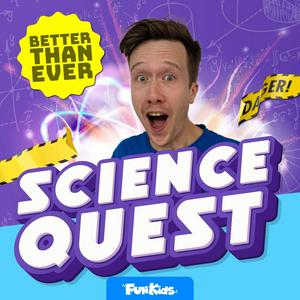
Sobre Fun Kids Science Quest
Exploring the coolest and most incredible stuff in science, from way back when dinosaurs roamed the Earth to a future where humans live in space!
Fun Kids Science Quest is hosted by Dan and is the perfect science podcast for kids and families everywhere. Each week, you'll find episodes from series like Deep Space High, Age of the Dinosaurs and Professor Hallux.
There's also a special guest, top experts answering all your science questions and Dangerous Dan - something scientific that’s also a little bit deadly!
You can listen to Dan on Fun Kids (weekdays from 1pm) on DAB Digital Radio across the UK, on the free Fun Kids app and online at funkidslive.com
Plus, when you become a Fun Kids Podcasts Plus subscriber, you get access to hundreds of episodes of the Fun Kids Science Weekly, but able to listen ad-free and get new episodes early! It's out of this world! Not only that you'll get similar benefits on over 30 Fun Kids podcasts plus you'll be safe in the knowledge that you're supporting Fun Kids in bringing high-quality, entertaining, and safe content for your family.
Find out more at FunKidsLive.com/plus
Sítio Web de podcastOuve Fun Kids Science Quest, Ciência Pop e muitos outros podcasts de todo o mundo com a aplicação radio.pt
Obtenha a aplicação gratuita radio.pt
- Guardar rádios e podcasts favoritos
- Transmissão via Wi-Fi ou Bluetooth
- Carplay & Android Audo compatìvel
- E ainda mais funções
Obtenha a aplicação gratuita radio.pt
- Guardar rádios e podcasts favoritos
- Transmissão via Wi-Fi ou Bluetooth
- Carplay & Android Audo compatìvel
- E ainda mais funções
Fun Kids Science Quest
Leia o código,
descarregue a aplicação,
ouça.
descarregue a aplicação,
ouça.
Fun Kids Science Quest: Podcast do grupo
 Portugal