
Ouve este podcast gratuitamente na aplicação: Descarrega gratuitamente na App Store
radio.pt
Sleeptimer
Guardar rádio
65 episódios
What Happens When AI Gets a Lab?
21/10/2026 | 1h 39minWhat happens when AI moves beyond the chatbot and into the laboratory? From Claude-designed proteins that bind scorpion toxins to robots that assemble optics experiments, we examine what AI can do for science and what still has to be proven in the real world.
Lester Nare and Krishna Choudhary explore the gap between generating a promising design and demonstrating that it works. We also unpack BrainChat, a research platform that lets epilepsy patients interact with their brain-recording data and contribute feedback to seizure detection, and a 15-year study of orangutan mothers facilitating playdates for their young.
Along the way: why binding a toxin is not the same as neutralizing it, how patient feedback can help personalize models, and what cloud laboratories and automated experiments could mean for scientific discovery. Which part of science do you think AI will change most?
CHAPTERS
00:00 Playdates, brain data and robot labs
00:29 Hello Internet and Signal Award celebration
02:40 Orangutan mothers and infant playdates
15:18 What 15 years of orangutan observations reveal
25:16 Testing the playdate hypothesis
39:30 BrainChat and patient-guided learning
44:57 Putting patients in the feedback loop
1:02:00 Personalizing seizure detection
1:05:33 What the BrainChat study does not yet establish
1:07:59 Anthropic scorpion-toxin binders
1:15:49 Why a toxin binder is not an antivenom
1:18:31 Fast AI designs, slower laboratory testing
1:19:40 Connecting AI to the physical lab
1:23:22 Robotic optics and automated laboratories
1:28:04 Cloud laboratories and remote experiments
1:33:00 Closing the loop with Lila Sciences
1:37:48 Wrap-up
RESEARCH & FURTHER READING
Orangutan maternal ranging and infant social play (PNAS):
https://pubmed.ncbi.nlm.nih.gov/42837467/
BrainChat and human-AI collaboration in epilepsy (Nature Medicine):
https://www.nature.com/articles/s41591-026-04680-4
Claude-designed scorpion-toxin binders (Anthropic):
https://www.anthropic.com/research/claude-scorpion-toxin-binder-design
Robotic optics experiments (MIT News):
EDITORIAL NOTES
The orangutan findings are observational evidence of mothers facilitating social play, not direct proof of conscious intent. BrainChat was a small feasibility study, not proof of improved clinical outcomes. The scorpion-toxin work demonstrated binding, not a validated antivenom.
On-screen clarifications:
15:20 The first author is Odd T. Jacobson. Maria A. van Noordwijk is a coauthor.
16:06 About 32,600 observation hours were collected over 15 years. That is roughly 3.7 years of continuous observation.
40:39 In epilepsy, deep brain stimulation reduces seizure frequency. Tremor is the Parkinson's disease example here.
47:07 The study included 13 participants: 11 with scalp EEG and 2 with intracranial EEG.
51:01 and 51:35 GPT-4o-mini ran in Penn's HIPAA-compliant Azure OpenAI cloud environment, not locally.
1:18:03 This was an Anthropic announcement, in collaboration with Citrini Research.
WATCH & LISTEN
Episode notes and research: https://ffppod.com/episodes/ep65
Watch and listen: https://ffppod.com
Apple Podcasts: https://podcasts.apple.com/us/podcast/id1830375095
Subscribe: https://www.youtube.com/@FromFirstPrinciplesPod?sub_confirmation=1
Support the show: https://ffppod.com/donate
Contact: https://ffppod.com/contact
Follow @FFPPod on Instagram, TikTok, X and Facebook.Nobel Prize 2026: The Science Gets Stranger
16/10/2026 | 1h 59minCan light restore aspects of sight? Can recalling a cold experience change an animal's metabolism? And what can ghost particles and mirror-image molecules tell us about the universe?
Lester Nare and Krishna Choudhary follow up on our 2026 Nobel Prize episodes with research building on optogenetics, IceCube and molecular handedness. We unpack an early human vision-restoration trial, cold-memory experiments in mice, cosmic neutrino flavors, and a tiny electrical sensor for distinguishing left- and right-handed amino acids.
Plus: how the Nobels work, our follow-up on the Nobel chemistry illustration, a brief look at neutrino Earth tomography, and why fundamental research matters. Which discovery would you like us to explore next?
CHAPTERS
00:00 Cold open: memory, neutrinos and mirror molecules
00:28 Hello Internet and how the Nobels work
04:32 Optogenetics recap
10:23 Restoring aspects of vision
25:43 Controlling movement in worms
29:31 Cold memories and metabolism
41:07 Memory, trauma and ethical questions
45:44 FFP housekeeping
48:17 IceCube recap
56:23 Measuring cosmic neutrino flavors
1:10:30 A brief look at neutrino Earth tomography
1:12:20 Why fundamental physics matters
1:26:58 Chemistry and molecular handedness
1:29:08 Correcting the Nobel illustration
1:39:30 Measuring chirality in tiny samples
1:46:42 Testing the sensor on meteorite and desert samples
1:51:22 Why these questions matter
1:57:20 Closing thoughts and signoff
RESEARCH & FURTHER READING
Optogenetic therapy for visual function (NEJM, 2026):
https://doi.org/10.1056/NEJMoa2602215
Cold memories and thermoregulation (Nature, 2025):
https://doi.org/10.1038/s41586-025-08902-6
Three-flavor composition of cosmic neutrinos (PRL, 2026):
https://doi.org/10.1103/vntd-m133
Chiral discrimination in meteorite and desert soil extracts (Nature Communications, 2026):
https://doi.org/10.1038/s41467-026-77947-6
Further reading, briefly mentioned: neutrino Earth tomography (preprint):
https://arxiv.org/abs/2607.02644
EDITORIAL NOTES
The vision trial was small and exploratory. The cold-memory findings discussed are from mice.
On-screen clarifications:
16:53 Both eyes were profoundly visually impaired; the worse-seeing eye was treated.
19:57 The untreated eye was patched during testing, not a normal-vision control.
54:41 Neutrino event rates depend on energy and selection, not just detector volume.
1:05:47 Flavor identification efficiency is distinct from interaction probability; both depend on energy.
1:13:35 Other astronomy-related Nobels include 2017 (LIGO) and 2019 (cosmology/exoplanets).
1:18:00 The LHC at CERN enabled the Higgs discovery; CERN itself was founded in 1954.
1:44:25 Both enantiomers produce current signals; waveform features distinguish them.
1:46:42 Murchison is a meteorite. Diego de Almagro and North of Antofagasta are soil sites.
1:47:40 The sensor study reports mixed agreement and limitations, not uniformly negative results.
1:49:00 Phobos is a Martian moon; a captured-asteroid origin is a hypothesis.
WATCH & LISTEN
Full video: https://youtu.be/C9K6onZxyN4
Episode notes: https://ffppod.com/episodes/ep64
Follow @FFPPod on Instagram, TikTok, X and Facebook.
Breaking down science news so it makes sense to curious people everywhere.Nobel Prize in Chemistry 2026 Explained: Mirror Molecules (EP 63)
07/10/2026 | 1h 20minWhy does life favor one molecular mirror image? The 2026 Nobel Prize in Chemistry honors Henri B. Kagan and Kenso Soai for nonlinear effects and autocatalysis in asymmetric organic synthesis.
Lester Nare and Krishna Choudhary unpack the science from first principles: chirality, Pasteur's crystals, enantiomeric excess, and how a tiny imbalance can grow into an overwhelming preference for one molecular hand.
We connect Kagan's catalyst discoveries and the Soai reaction to medicines, the origins of biological handedness, and the serious concerns around hypothetical mirror life. Plus: symmetry in physics, Frances Oldham Kelsey and thalidomide, and our interpretation of a Nobel illustration.
CHAPTERS
00:00 Why life has a molecular handedness
01:33 Hello Internet
02:49 The 2026 Chemistry laureates
06:24 Chirality and mirror-image molecules
12:10 Pasteur and the history of handedness
19:36 Why is life's chemistry one-handed?
24:35 Frank and the origin-of-life puzzle
29:14 Enantiomeric excess explained
30:30 Kagan and nonlinear effects
38:58 FFP and symmetry in physics
42:20 Soai and asymmetric autocatalysis
51:28 Why chirality matters for medicine
58:21 What this does and does not explain about life
1:00:25 Mirror life and biological risk
1:10:37 Examining the Nobel illustration
1:14:10 Recap and Nobel week reflections
RESEARCH & FURTHER READING
Original papers and supporting context:
Frank's model (1953): https://doi.org/10.1016/0006-3002(53)90082-1
Puchot, Kagan et al. (1986): https://doi.org/10.1021/ja00269a036
Soai et al. (1995): https://doi.org/10.1038/378767a0
Sato et al., amplification (2003): https://doi.org/10.1002/anie.200390105
Mirror-life risks (2024): https://doi.org/10.1126/science.ads9158
Nobel announcement: https://www.nobelprize.org/prizes/chemistry/2026/press-release/
EDITORIAL NOTES
Intro: the 50:50 example describes an unbiased synthesis, not all chemistry. The Soai reaction is a clue to amplification, not proof of how life began.
On-screen clarifications:
04:38 B-DNA is right-handed; Z-DNA can form a left-handed helix.
13:56 Pasteur separated sodium ammonium tartrate crystals.
18:48 L/D configuration does not specify optical rotation.
19:10 Proteins mainly use L-amino acids; DNA/RNA use D-sugars.
22:55 Mentos mainly triggers CO2 bubble nucleation.
27:18 Asymmetric catalysis and autocatalysis are distinct.
34:07 0.25 × 0.25 = 0.0625 = 6.25%.
36:31 Inactive mixed catalyst pairs are a simplified model.
37:55 The normalized product-ratio curve need not be parabolic.
42:04 Wu: preferential emission opposite spin; antineutrinos also emitted.
45:30 5-pyrimidyl alkanol; an alkanol is an alcohol.
47:10 The tiny-imbalance result is Sato et al. (2003), cited above.
47:40 A demonstration of symmetry breaking by asymmetric autocatalysis.
49:09 Above 99.5% ee means above 99.75% majority form, not exactly 100%.
49:57 0.00005% excess is 1 part in 2,000,000.
52:44 Thalidomide enantiomers interconvert in the body.
53:36 Merrell applied in the U.S.; Kelsey withheld approval. Trial exposure occurred.
1:02:09 Mirror-life catastrophe is a serious risk, not an observed outcome.
1:03:28 Antibodies are adaptive immunity, not innate immunity.
1:03:53 Impaired recognition does not mean proven total immune invisibility.
1:04:27 Some treatments might work; ecosystem protection is very difficult.
1:04:56 No reproducing mirror organism has been reported.
1:09:19 Chimeras and genetic modification are not interchangeable.
1:10:37 The Nobel-diagram critique is our interpretation, not an official correction.
1:11:51 Solid wedge: toward; hashed wedge: away; ordinary line: neither.
WATCH & FOLLOW
Full video: https://youtu.be/Wdapv1hFT4w
Episode notes: https://ffppod.com/episodes/ep63
Follow @FFPPod on Instagram, TikTok, X and Facebook.
Breaking down science news so it makes sense to curious people everywhere.Nobel Prize in Physics 2026 Explained: IceCube & Neutrinos (EP 62)
06/10/2026 | 1h 2minWhy build a telescope inside a billion tons of Antarctic ice? The 2026 Nobel Prize in Physics recognizes Francis Halzen's work on IceCube and the discovery of high-energy neutrinos from the cosmos.
In Episode 62 of From First Principles, Lester Nare and Krishna Choudhary explain neutrinos from the ground up: why these elusive particles make powerful cosmic messengers, how faint flashes of Cherenkov light reveal their interactions, and why detecting them requires an observatory buried deep beneath the South Pole.
We follow the path from beta decay and the first neutrino experiments to AMANDA, IceCube's construction, the 2013 astrophysical breakthrough, a distant blazar, and a neutrino map of the Milky Way. Along the way: cosmic rays, the Oh-My-God particle, tracks versus cascades, and the international collaboration behind the discovery.
CHAPTERS
00:00 Hunting ghost particles beneath Antarctica
01:16 Hello Internet and Nobel Prize
05:30 What are neutrinos?
10:00 Neutrinos as cosmic messengers
15:02 The Oh-My-God particle
16:21 Cosmic-ray energies
19:07 Cosmic particle accelerators
22:28 Why look for neutrinos?
25:52 How to detect a neutrino
29:23 Cherenkov light
33:13 Building a neutrino observatory
37:17 From Antarctic ice to AMANDA
42:21 Building IceCube
44:59 Reading tracks and cascades
49:30 Backgrounds and the 2013 discovery
52:46 Tracing cosmic neutrino sources
54:16 Mapping the Milky Way
58:23 IceCube collaboration and Gen2
1:01:05 Closing and Nobel week
RESEARCH & FURTHER READING
AMANDA in Antarctic ice (2001): https://doi.org/10.1038/35068509
IceCube detector and instrumentation (2017): https://doi.org/10.1088/1748-0221/12/03/P03012
First PeV neutrinos (2013): https://doi.org/10.1103/PhysRevLett.111.021103
Astrophysical neutrino evidence (2013): https://doi.org/10.1126/science.1242856
Blazar TXS 0506+056 (2018): https://doi.org/10.1126/science.aat1378
Archival blazar neutrino emission (2018): https://doi.org/10.1126/science.aat2890
Milky Way neutrino map (2023): https://doi.org/10.1126/science.adc9818
Gamma-ray burst constraints (2012): https://doi.org/10.1038/nature11068
IceCube overview: https://icecube.wisc.edu/science/icecube/
EDITORIAL NOTES
Intro: the 2013 breakthrough was high-energy astrophysical neutrinos. Lower-energy supernova neutrinos were detected in 1987.
On-screen clarifications:
06:45 Beta-minus decay produces a proton, electron and electron antineutrino.
11:10 Davis studied solar neutrinos; Koshiba's team detected SN 1987A neutrinos.
17:50 The cosmic-ray knee and ankle are not fixed distance boundaries.
19:38 Required accelerator size depends on magnetic-field strength.
24:18 Ground-based telescopes also detect gamma rays through air showers.
27:48 W interactions produce charged leptons; Z scattering preserves neutrino flavor.
34:06 The underwater concept dates to 1960; DUMAND developed in the 1970s.
36:09 Baikal holds about one-fifth of unfrozen surface freshwater.
38:53 Earth filters muons but also absorbs many very-high-energy neutrinos.
41:26 Pressure converts air bubbles into clathrates, reducing light scattering.
42:28 Construction finished in December 2010; full operations began in May 2011.
44:27 Sensors are DOMs; DeepCore is a densely instrumented detector region.
45:47 Timing gives direction; light yield and pattern help estimate energy.
49:44 Upgoing events can still be atmospheric neutrinos.
53:12 TXS 0506+056 is about 3.7 billion light-years away.
56:38 Long GRBs often involve collapsing stars; short GRBs often involve mergers.
WATCH & FOLLOW
Full video: https://youtu.be/eMahxeBj5k0
Episode notes: https://ffppod.com/episodes/ep62
Medicine Nobel explained: https://youtu.be/PKAYqhy8xf8
Follow @FFPPod on Instagram, TikTok, X and Facebook.
From First Principles: Breaking down science news so it makes sense to curious people everywhere.Nobel Prize in Medicine 2026 Explained: Optogenetics (EP 61)
05/10/2026 | 1h 11minHow do you prove what a brain cell actually does? The 2026 Nobel Prize in Medicine celebrates a remarkable answer: give cells a light-sensitive protein, then switch their activity on or off with light.
In Episode 61 of From First Principles, Lester Nare and Krishna Choudhary explain optogenetics from the ground up and trace the discoveries of Peter Hegemann, Georg Nagel and Karl Deisseroth. We follow the story from algae swimming toward light to channelrhodopsins, precisely controlled neurons, and experiments probing memory, reward and behavior. Then we explore heart-brain connections, early attempts to restore vision, and what these experiments can and cannot tell us.
CHAPTERS
00:00 The discovery that put brain cells under light control
02:34 Hello Internet
03:28 2026 Medicine Nobel and optogenetics
05:38 Understanding the brain
08:42 From correlation to causation
18:13 Controlling neurons with light
21:25 Early optogenetics and the chARGe system
24:17 Light-sensitive microbial proteins
26:26 Algae and phototaxis
31:42 Discovering channelrhodopsins
34:42 Nagel and light-gated ion channels
40:55 Controlling mammalian neurons
50:19 Expanding the optogenetic toolkit
56:10 Neural circuits and behavior
59:02 Memory, reward and reinforcement
1:02:53 Heart rhythm and emotion
1:04:02 Beyond the brain and toward medical treatments
1:06:56 Implications and limits
1:09:10 Closing and Nobel week
RESEARCH & FURTHER READING
Full paper list: https://ffppod.com/episodes/ep61
Nobel Prize announcement and background:
https://www.nobelprize.org/prizes/medicine/2026/summary/
Optical control of neurons: https://doi.org/10.1038/nn1525
Memory recall in mice: https://doi.org/10.1038/nature11028
Partial visual recovery: https://doi.org/10.1038/s41591-021-01351-4
EDITORIAL NOTES
On-screen clarifications are included at these timestamps:
13:46 The Jennifer Aniston neuron was recorded in human patients. Selective firing alone did not establish that it causes recognition.
30:34 Vertebrate rhodopsin is a GPCR. In rods and cones, light closes cGMP-gated channels and causes hyperpolarization.
35:12 Xenopus oocytes are immature frog egg cells, not embryos.
39:52 Calcium entry triggers neurotransmitter release; neurotransmitters carry the signal across the synapse. ChR2 conducts several positive ions, not just calcium.
52:17 Halorhodopsin is a light-driven chloride pump, not a channel.
1:03:18 The heart-pacing study expressed ChRmine in mouse heart muscle cells, not neurons.
Animal studies and early clinical results are distinguished from established treatments.
WATCH & LISTEN
Watch this episode: https://youtu.be/PKAYqhy8xf8
Our Nobel predictions: https://open.spotify.com/episode/4xuoH7WhM5svq8vEJPL3Ce
Support: https://ffppod.com/donate
Contact: https://ffppod.com/contact
Follow @FFPPod.
Breaking down science news so it makes sense to curious people everywhere.
Mais podcasts de Ciência
Podcasts em tendência em Ciência



Sobre From First Principles
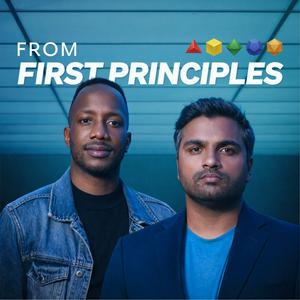
From First Principles is a fast, funny, and rigorous breakdown of the biggest science stories of the week, hosted by Lester Nare and physicist Krishna Choudhary, PhD. We go past headlines into the actual mechanics: what happened, why it matters, and what everyone’s missing.
Expect physics, space, AI, energy, biotech, and the occasional “wait… is that real?” story. If you’re curious, skeptical, and you like learning in public — you’re in the right place.
Sítio Web de podcastOuve From First Principles, Inteligência Emocional • O Podcast e muitos outros podcasts de todo o mundo com a aplicação radio.pt
Obtenha a aplicação gratuita radio.pt
- Guardar rádios e podcasts favoritos
- Transmissão via Wi-Fi ou Bluetooth
- Carplay & Android Audo compatìvel
- E ainda mais funções
Obtenha a aplicação gratuita radio.pt
- Guardar rádios e podcasts favoritos
- Transmissão via Wi-Fi ou Bluetooth
- Carplay & Android Audo compatìvel
- E ainda mais funções
From First Principles
Leia o código,
descarregue a aplicação,
ouça.
descarregue a aplicação,
ouça.
 Portugal