
Ouve este podcast gratuitamente na aplicação: Descarrega gratuitamente na App Store
radio.pt
Sleeptimer
Guardar rádio
15 episódios
Airbnb CEO Brian Chesky on the founder’s role and bridging Silicon Valley’s AI divide
22/10/2026 | 53min“What if design just ran the boardroom?”
In this episode of The CEO Signal with Penny Pritzker and Andrew Edgecliffe-Johnson, Airbnb CEO Brian Chesky explains how his training as an industrial designer shapes his unconventional approach to running the company. He describes Airbnb as a three-dimensional model in his head and explains why he remains so personally involved in recruiting and organizational decisions.
“The founder is the keeper of the dream,” he says.
On artificial intelligence, Chesky warns that Silicon Valley is losing touch with the people whose lives its technologies will transform. “Society feels like AI is happening to them, not for them,” he says. Chesky believes the industry needs bridge builders to reconnect with people beyond the Silicon Valley bubble. And he thinks he could help.Inside the Breakup of an American Industrial Giant
08/10/2026 | 50minAfter nearly four decades at Honeywell, Vimal Kapur reached the top — and then took on the task of breaking the 140-year-old industrial conglomerate into three companies.
Kapur tells Penny Pritzker and Andrew Edgecliffe-Johnson how he managed that separation while simultaneously building Honeywell Technologies into a focused automation company, reshaping its portfolio and deciding where the new business should compete. The challenge, he says, is capturing the advantages of focus without giving up the benefits of scale.
A big part of that judgment comes from staying close to customers. Kapur explains why he tries to spend roughly a third of his time with them, how those conversations help test major strategic decisions, and why he believes “the CEO should have a founder’s mindset” when it comes to products, innovation and the future of the business.Motorola Solutions CEO Greg Brown on the “Relief or Regret” Rule
24/09/2026 | 48min“Relief or regret?” That is the question Motorola Solutions Chairman and CEO Greg Brown uses to test consequential decisions.
In a candid conversation with Penny Pritzker and Andrew Edgecliffe-Johnson, Brown explains how nearly two decades of reinvention, activist pressure and private-equity involvement changed the way he leads. Working with activists made him more accountable and pushed him, he says, from thinking “like a manager” to thinking “like an owner.”
He is equally open about the moments when that judgment was tested. When Motorola Solutions’ board considered selling the company, Brown told directors: “This is bullshit. And if you want to fire me, go ahead and fire me.” He later apologized for the delivery, but not the substance, then ran the process the board had asked for. No buyer emerged, but the process ultimately led to Silver Lake investing in Motorola.
Brown also explains how he decides what Motorola should build, buy or partner on, and how he keeps the company moving through successive reinventions without losing sight of what should remain core.United Airlines CEO Scott Kirby on calculated bets and building a US flag carrier
10/09/2026 | 51minUnited Airlines CEO Scott Kirby wants to build what he calls the “undisputed flag carrier of the United States.” He argues that airlines are not commodities and that greater scale could benefit customers, but acknowledges a fundamental obstacle to consolidation: “We can’t get it done without a willing partner, and we don’t have one.”
In this episode of The CEO Signal, Kirby discusses the decade-long push to transform United and how he thinks about the bets required to do it. A former card counter who says senior executives should play high-stakes poker with their own money, Kirby warns against assuming the answer is in the spreadsheet. “The important thing,” he says, is to understand and question the assumptions.
Hosted by Penny Pritzker and Andrew Edgecliffe-Johnson, the conversation also looks back at United’s aircraft strategy during Covid. As competitors retired widebody aircraft and shrank their fleets, United moved in the opposite direction. Kirby believed the risk-reward had shifted: “We don’t actually have to be totally right,” he told the board. “We just have to not be totally wrong.” Kirby also explains why building employee pride means eliminating the things employees have to apologize for, and why a CEO’s job is “not to work hard. It’s to think hard.”
The CEO Signal is Semafor's interview platform for conversations with the global CEOs whose decisions are shaping the future of the new world economy. Hosted by Penny Pritzker and Andrew Edgecliffe-Johnson, the show explores the moments of judgment that define leadership.
Penny Pritzker is the founder and chairman of PSP Partners and served as U.S. Secretary of Commerce from 2013 to 2017.
Andrew Edgecliffe-Johnson is CEO Editor at Semafor and a former Financial Times journalist who has spent decades covering global companies and corporate leadership.Jon Gray, President and COO, Blackstone on AI, Private Credit and Big Bets
27/08/2026 | 50minJon Gray, chief operating officer of the $1.3 trillion asset manager Blackstone, says one of the firm’s distinguishing habits is to “go big” when it finds a theme it believes in. But he also says successful convictions need to be challenged, particularly as Blackstone invests heavily around artificial intelligence. “You keep pressing against what you’re doing to confirm that you haven’t just sort of fallen in love,” he says.
In this episode of The CEO Signal, Gray describes investing as “pattern recognition”: finding “good neighborhoods,” and connecting the dots before others do. Hosted by Penny Pritzker and Andrew Edgecliffe-Johnson, the conversation also explores how Blackstone makes investment decisions at scale and why Gray worries strong systems can “stamp out the entrepreneurial spirit.”
Gray also addresses the current debate around private credit. He says lower returns as rates fall and spreads tighten would be a “totally reasonable criticism,” while rejecting claims that the asset class is creating systemic risk or heading for collapse as “not very logical.”
The CEO Signal is Semafor's interview platform for conversations with the global CEOs whose decisions are shaping the future of the new world economy. Hosted by Penny Pritzker and Andrew Edgecliffe-Johnson, the show explores the moments of judgment that define leadership.
Penny Pritzker is the founder and chairman of PSP Partners and served as U.S. Secretary of Commerce from 2013 to 2017.
Andrew Edgecliffe-Johnson is CEO Editor at Semafor and a former Financial Times journalist who has spent decades covering global companies and corporate leadership.
Mais podcasts de Empreendedorismo




Podcasts em tendência em Empreendedorismo






Sobre The CEO Signal
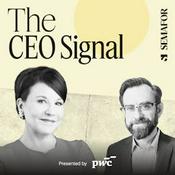
When the business world moves, these are the leaders making the decisions that shape it. The CEO Signal is a new show hosted by Penny Pritzker — investor, business builder, and former U.S. Secretary of Commerce — and Andrew Edgecliffe-Johnson, Semafor’s CEO Editor. Episodes are released every two weeks. Building on The CEO Signal newsletter, read by the world’s top chief executives, the show brings that perspective to candid conversations with the leaders running the world’s biggest companies.
The CEO Signal is presented by PwC.
Ouve The CEO Signal, Bitalk e muitos outros podcasts de todo o mundo com a aplicação radio.pt

Obtenha a aplicação gratuita radio.pt
- Guardar rádios e podcasts favoritos
- Transmissão via Wi-Fi ou Bluetooth
- Carplay & Android Audo compatìvel
- E ainda mais funções
Obtenha a aplicação gratuita radio.pt
- Guardar rádios e podcasts favoritos
- Transmissão via Wi-Fi ou Bluetooth
- Carplay & Android Audo compatìvel
- E ainda mais funções

The CEO Signal
Leia o código,
descarregue a aplicação,
ouça.
descarregue a aplicação,
ouça.
The CEO Signal: Podcast do grupo
 Portugal

