

Ouve este podcast gratuitamente na aplicação: Descarrega gratuitamente na App Store
radio.pt
Sleeptimer
Guardar rádio
74 episódios
Our Lands Are Who We Are: Indigenous Science, Ecological Grief and Decolonising Research with Dr. Jessica Hernandez
13/08/2026 | 29minWhat happens to your sense of self when the lands that define you are taken away?
Dr. Jessica Hernandez is an Indigenous environmental scientist, author, and founder of Earth Daughters — an Indigenous-led collective supporting indigenous women and youth through mutual aid and climate justice initiatives. Of Binnizá and Ch'orti' Maya heritage, displaced from her ancestral homelands in Oaxaca and Central America, Jessica has spent her career doing what Western academia rarely allows: putting indigenous communities in charge of their own research.
In this conversation with Sara, Jessica speaks candidly about the dualities she navigates daily — as a displaced Indigenous woman, as a scientist trained in Western methods who refuses to extract knowledge from communities, as an advocate who must resist the individualistic mindset embedded in academia. She talks about ecological grief — the profound sadness that comes when lands are desecrated, even by well-intentioned renewable energy projects built without indigenous consent. She talks about the milpa — the communal agricultural system that embodies everything capitalism has erased. And she talks about Earth Daughters, which began as a mutual aid effort after an earthquake devastated Oaxaca in 2020 and has since grown into a nonprofit running projects from Bolivia to Guatemala to Colombia.
"Our lands are who we are, who we become, and what we hold."
In this episode:
What displacement does to identity — and why the longing to return never leaves
Why Western research is often extractive — and how to do it differently
The hardest part of bridging indigenous knowledge and Western science in academia
Ecological grief: what happens to your soul when the lands are taken
How colonisation erased indigenous histories — and how education can help break the cycle
The milpa: an indigenous agricultural system that embodies communal living
Earth Daughters: from earthquake mutual aid to nonprofit projects across Latin America
A call to action: pay attention to what is happening in the US — and advocate globally
About Dr. Jessica Hernandez:
Dr. Jessica Hernandez is an Indigenous environmental scientist of Binnizá and Ch'orti' Maya heritage, author of Fresh Banana Leaves and Growing Papaya Trees, and founder of Earth Daughters — an Indigenous-led nonprofit supporting indigenous communities through mutual aid, climate justice, and community-led research projects in Bolivia, Guatemala, and Colombia.
We Need to Act is a podcast about the people, ideas, and movements shaping a better now.The Fashion Industry Is Broken And Ghana Is Paying the Price with Yayra Agbofah
30/07/2026 | 23minWhat does your wardrobe have to do with a beach in Ghana covered in discarded clothing?
Yayra Agbofah grew up trading secondhand garments at Kantamanto Market in Accra — one of the largest secondhand clothing markets in Africa, where millions of garments arrive every single week. He saw firsthand what happens to the ones that don't sell: they end up in rivers, in landfills, on beaches. He also saw something else: extraordinary creativity. Tailors transforming discarded fabric. Traders extending the life of damaged clothes. Communities practicing circularity long before it became a sustainability buzzword.
In 2018, Yayra founded The Revival — a community-driven upcycling initiative that transforms textile waste into products, education, and opportunity. Named one of TIME magazine's 100 Most Influential Climate Leaders of 2025, he has since redirected an estimated 12 million garments from landfill, reduced CO2 emissions by more than 12,000 metric tons, and built free online courses so communities around the world can learn from the knowledge developed at Kantamanto.
In this conversation with Sara, Yayra makes the case that fashion's crisis is not just environmental — it is a story of inequality, colonialism, and extraction, where the Global South pays the price for the Global North's overconsumption. He talks about what the future of fashion could look like, why synthetic materials need to go, and why the most important question a consumer can ask is: where is this garment going to end up?
"It has always been dignity over charity. We're not trying to save communities — we're trying to build together with them."
In this episode:
How Ghana became the epicentre of global textile waste — and who pays the real price
Why Kantamanto Market is not a dumping ground but a space of innovation and resilience
What the Global South actually needs from the fashion industry — not charity, but accountability
The Revival: upcycling, education, job creation, and free online courses from Accra
Why fast fashion is a story of extraction — of labour, resources, and now waste
What the future of fashion should look like: slower, more local, more honest
Why synthetic materials are the driving force of fast fashion — and need to be abolished
A call to action: think about where every garment ends up before you buy it
About Yayra Agbofah:
Yayra Agbofah is the founder and creative director of The Revival, a community-driven sustainable fashion initiative based in Accra, Ghana. Named one of TIME magazine's 100 Most Influential Climate Leaders of 2025, he has spent over seven years working at the intersection of textile waste, circular economy, and community empowerment. The Revival has diverted an estimated 12 million garments from landfill and reduced CO2 emissions by more than 12,000 metric tons.
https://www.therevival.earth/
We Need to Act is a podcast about the people, ideas, and movements shaping a better now.Environmental Law and Climate Change: Why Collective Action Is Our Most Powerful Tool with Daniel Farber
23/07/2026 | 28minWhat happens to environmental law when the federal government turns its back on climate action?
Dan Farber is the Sho Sato Professor of Law at UC Berkeley and one of the most respected voices in US environmental and constitutional law. A former law clerk to Justice John Paul Stevens of the US Supreme Court, he has spent decades at the intersection of environmental policy, democracy, and justice.
In this conversation with Sara, Dan offers a clear-eyed and surprisingly hopeful assessment of where we are. He talks about why simply limiting emissions is no longer enough — and why we need to think seriously about what we are going to build in place of the fossil fuel world. He talks about the role of state governments as the real drivers of durable climate action in the US, and about why California and other states are effectively doing the lab work for the federal government. He speaks about environmental justice — who is most exposed to risk, who is most vulnerable, and why those two things are not always the same. And he addresses political polarisation head-on, arguing that climate change was never and should never be a left-right issue.
But the most important message he leaves is this: change is not all or nothing. Every ton of carbon we stop emitting makes the world a little bit better. And collectively — in communities, in states, in cities — we are far more powerful than we feel.
In this episode:
What environmental law actually is — and why companies won't act without it
Why limiting emissions alone is not enough — the case for investment-led climate policy
How the war in the Middle East is accelerating the global energy transition
Why state and local governments are the real engine of durable climate action in the US
Environmental justice: who is most exposed, who is most vulnerable — and why these aren't the same
Political polarisation and climate change — how we got here and how we get past it
Why democracy, despite its slowness, produces more durable climate solutions than authoritarianism
What ordinary citizens can actually do — from voting with their wallet to writing to their state legislators
Why community is the antidote to powerlessness
About Dan Farber:
Dan Farber is the Sho Sato Professor of Law at the University of California, Berkeley, where he leads two research centres focused on law, energy, environment, and democracy. A former law clerk to Justice John Paul Stevens of the US Supreme Court, he is a member of the American Academy of Arts and Sciences and the author of several influential books including Eco-Pragmatism and Contested Ground: How to Understand the Limits on Presidential Power.
We Need to Act is a podcast about the people, ideas, and movements shaping a better now.Six Years Without Salmon: Sámi, Europe's Only Indigenous People on Climate Change with Áslat Holmberg
16/07/2026 | 40minWhat does it mean to watch the river that shaped your entire life fall silent?
Áslat Holmberg is a former member of the Sámi Parliament of Finland and former President of the Saami Council — a salmon fisher, teacher, and holder of a master's degree in indigenous studies whose work expertise includes human rights, culture, indigenous knowledge, and environmental policy. He grew up in Njuorggán, the northernmost village in Finland, fishing salmon in the Teno River from the age of two. Today, that river is in its sixth consecutive year of complete salmon fishery closure — with stocks at roughly 1% of a healthy population.
In this conversation with Sara, Áslat shares what it means to be part of Europe's only indigenous people — a community of around 100,000 people largely invisible in European institutions, rarely taught in European schools, and yet holding some of the most profound ecological knowledge on the continent. He talks about the dramatic changes the Arctic is undergoing: collapsing salmon stocks, reindeer herding disrupted by rain in January, and insects arriving all at once. And he talks about the Sami worldview — the tradition of asking permission before entering a place, the rule of leaving it exactly as you found it, and the understanding that humans are not above other species, but simply one among many.
This is a conversation about identity, self-sufficiency, indigenous rights, and what Europe still has to learn from the people who have lived in the north for thousands of years.
In this episode:
Who are the Sami — Europe's only indigenous people — and why are they so little known?
Six consecutive years of complete salmon fishery closure — and what that means for a community
How climate change is transforming reindeer herding across the Arctic
The Sami worldview: asking permission, leaving no trace, humans as one species among many
The gap between Sami rights on paper and real decision-making power in practice
Why protecting the human rights system and protecting the environment are the same struggle
About Áslat Holmberg:
Áslat Holmberg is from Njuorggán, situated on the banks of the great river Deatnu at the border between Finland and Norway. He has worked for over a decade with Sámi and indigenous issues through NGOs, activism, and academia. He is a former President of the Saami Council and former member of the Sámi Parliament of Finland. He is a salmon fisher and teacher and holds a master's degree in indigenous studies. His work expertise includes human rights, culture, indigenous knowledge, and environmental policy.Do Not Try to Save the Earth - The Earth Is Here to Save You with Paul Hawken
08/07/2026 | 48minWhat if the climate narrative itself is the problem?
Paul Hawken is one of the world's most influential environmentalists, entrepreneurs, and authors. Founder of Project Drawdown and Project Regeneration, and New York Times bestselling author of nine books — including The Ecology of Commerce, Drawdown, Regeneration, and his latest, Carbon: The Book of Life (2025) — he has spent over 50 years working at the intersection of ecology, commerce, and regeneration.
In this conversation with Sara, Paul challenges the very language of the climate movement — the word "sustainability," the phrase "climate crisis," the idea that we can "fix" the Earth. He argues that treating nature as something "out there" to be saved or managed — what he calls "othering" — is not just intellectually wrong. It is why, after 50 years of knowing exactly what to do, less than 1% of the world is doing anything about it on a daily basis.
He talks about carbon not as a villain but as the source of all life itself — present in 10 billion molecules in every cell of your body. He speaks about indigenous languages as the deepest ecological teaching humanity has ever produced. He introduces the Parliament of Earthlings — the idea that there are 3.9 trillion voices on this planet, most of which we never listen to. And he shares the Alliance for Earth, a new global platform connecting regenerative communities across 105 languages.
But beneath all of it runs one conviction: that the largest movement in human history is already arising — quietly, everywhere, in small communities dedicated to restoring life. And it closes with a line that will stay with you long after the episode ends.
"Do not try to save the Earth. The Earth is here to save you."
In this episode:
Why the climate narrative has failed — and what "othering" nature really means
Why carbon is not a villain but the source of all life — and what we lost by demonising it
Why "sustainability" is a meaningless word — and what to say instead
How Western noun-based languages keep us separate from the living world — and what indigenous verb-based languages teach us
Why capitalism cannot deliver regeneration — and what natural capital would actually look like
The Parliament of Earthlings: what it means to listen to 3.9 trillion voices
Elephants communicating through concrete walls, and mother bats naming their children
The Alliance for Earth: connecting regenerative communities across 105 languages
Why the largest movement in human history is already happening — and why we can't see it
About Paul Hawken:
Paul Hawken is a renowned environmentalist, entrepreneur, and author committed to the regeneration of nature and humanity. Founder of Project Drawdown and Project Regeneration, he is the author of nine books — six of them New York Times bestsellers — including The Ecology of Commerce, Blessed Unrest, Drawdown, Regeneration, and his latest, Carbon: The Book of Life (Viking/Penguin, 2025). He has received six honorary doctorates and lives in the Cascade Creek watershed with his wife Jasmine — alongside coyotes, foxes, bobcats, ravens, red-tail hawks, and pileated woodpeckers.
We Need to Act is a podcast about the people, ideas, and movements shaping a better now.
Mais podcasts de Ciência
 Fricção CientíficaCiência, Sociedade e cultura
 E o Resto é... CiênciaCiência, Ciências da Terra
 Making Sense with Sam HarrisCiência, Filosofia, Notícias, Política, Religião, Religião e espiritualidades, Sociedade e cultura
 Sean Carroll's Mindscape: Science, Society, Philosophy, Culture, Arts, and IdeasCiência, Filosofia, Física, Sociedade e cultura
 Mais lento do que a luzCiência
 UnexplainableCiência, Ciências da Vida
 RadiolabCiência, Ciências Naturais, Documentário, História, Sociedade e cultura
 The Joy of WhyCiência, Ciências da Vida
 Inteligência Emocional • O PodcastCiência, Ciências Sociais
 Boring History for SleepCiência, Ciências Sociais
Podcasts em tendência em Ciência
 Let's Rock - Um podcast da Idade da PedraCiência
 You Are Not So SmartCiência, Ciências Sociais, Ensino, Sociedade e cultura
 RadiowissenCiência
 Espacio en blancoCiência
 Live Like a Girl with Dr. Mindy PelzCiência, Nutrição, Saúde alternativa, Saúde e fitness
 NaruhodoCiência, Ciências Sociais, Ciências da Vida, Enriquecimento individual, Ensino
 Aha! Zehn Minuten Alltags-WissenCiência, Ensino, Saúde e fitness
 Science QuicklyCiência
 Dr Karl PodcastCiência
 Science FridayCiência, Ciências Naturais, Ciências da Terra, Ciências da Vida
 Podcast Liberta-teCiência, Natureza
 TheThinkingAtheistCiência, Ensino, Sociedade e cultura
 EmonthebrainCiência
 Do ZeroCiência, Ciências Sociais
 New Books in PsychoanalysisCiência
 Sasquatch ChroniclesCiência, Ciências Naturais, Sociedade e cultura
 Real Organic PodcastCiência, Ciências da Terra, Negócios, Nutrição, Saúde e fitness, Sem fins lucrativos
Sobre We Need to Act
We Need to Act, hosted by Dr. Sara Rego, dives into the biggest questions shaping our planet’s future. From climate change and biodiversity loss to social justice and environmental degradation, each episode unpacks what sustainability really means. Through candid conversations with activists, scientists, Indigenous leaders, entrepreneurs, and policymakers, we explore the roots of today’s crises—and the bold actions needed to build a just, resilient, and regenerative world.
Sítio Web de podcastOuve We Need to Act, Fricção Científica e muitos outros podcasts de todo o mundo com a aplicação radio.pt
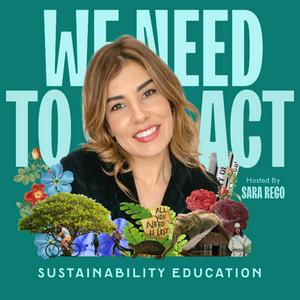
Obtenha a aplicação gratuita radio.pt
- Guardar rádios e podcasts favoritos
- Transmissão via Wi-Fi ou Bluetooth
- Carplay & Android Audo compatìvel
- E ainda mais funções
Obtenha a aplicação gratuita radio.pt
- Guardar rádios e podcasts favoritos
- Transmissão via Wi-Fi ou Bluetooth
- Carplay & Android Audo compatìvel
- E ainda mais funções

We Need to Act
Leia o código,
descarregue a aplicação,
ouça.
descarregue a aplicação,
ouça.
 Portugal