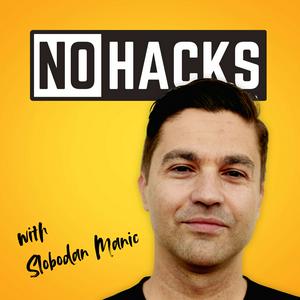
PodcastsEmpreendedorismoNo Hacks: Web Strategy for the AI Age

No Hacks: Web Strategy for the AI Age

Slobodan "Sani" Manić
No Hacks: Web Strategy for the AI Age
Último episódio

222 episódios

  • No Hacks: Web Strategy for the AI Age

    222: AI Visibility Is a Vanity Metric with Wil Reynolds

    01/04/2026 | 52min
    Wil Reynolds, founder of Seer Interactive, shares how losing 80% of organic traffic actually revealed that his team had been tracking the wrong metrics for years. We get into why AI visibility is a vanity metric, how 44% of LLM users include brand names in their prompts, the real security risks of wrong phone numbers in AI answers, and why trust (not visibility) is the only moat that matters.
    Chapters
    00:00 - 80% traffic drop, pipeline went up
    06:43 - The pressure of experimental channels with real budgets
    08:28 - AI visibility is a vanity metric
    13:49 - People are tracking the wrong prompts
    17:15 - AI is getting your phone number wrong (and scammers know it)
    22:30 - Trust vs visibility: the real optimization target
    30:26 - Trust is a moat, hacks mortgage your brand
    32:20 - Be seen, be believed, be chosen
    44:15 - What digital marketers should do right now
    49:33 - Where to find Wil
    Key Takeaways
    Traffic is no longer the leading indicator - Seer lost 80% of their organic traffic over two years. Pipeline went up. Social converts at 5x organic. The correlation between search traffic and revenue has broken for many businesses
    AI visibility is a vanity metric - When ChatGPT doubles the length of an answer, your "visibility" goes up without any more humans seeing you. If visibility grows but leads don't, you're the sucker. Track visibility against your pipeline, not in isolation
    44% of LLM users put brand names in their prompts - Wil's team watched real humans use LLMs and found nearly half include specific brands. Head-to-head brand comparisons are the prompts worth tracking, not generic category queries
    Trust is the only real moat - Michelin built a restaurant guide in 1900 that still drives foot traffic and pricing power. RAMP launched 52 AI-generated restaurant pages in a day. One is rotisserie chicken made by a chef. The other is a chicken nugget. Both are chicken, but only one builds trust
    Be seen, be believed, be chosen - Visibility gets you in the room. But if people Google your team and nobody shares their content, if you're not speaking at conferences, if your newsletter has no engaged readers, belief falls apart. Trust transfers from people, not listicles
    Concepts Discussed
    Three Types of AI Search | Search-led (web index + AI), answer-led (hybrid with tool use), and fully generative (training data only). Each requires different optimization.
    Training Data Lag | Gemini 3.1 launched with training data from January 2025, a 16-month gap. Work done since then has zero provable impact on training-data-based answers.
    Brand-in-Prompt Behavior | 44% of observed LLM users include brand names in their prompts. Changes the optimization target from "show up for generic queries" to "win head-to-head comparisons".
    Phone Number Hallucination | LLMs serve wrong phone numbers for businesses, creating fraud exposure. Especially dangerous for financial services targeting elderly customers.
    Recommended Stack Visibility | AI coding tools recommend tech stacks from training data. Being the default recommendation in Claude Code or Codex creates durable, hard-to-displace visibility.
    Connect with Wil Reynolds
    LinkedIn: linkedin.com/in/wilreynolds
    LinkedIn Newsletter: Thinking Out Loud
    Seer Interactive: seerinteractive.com
    No Hacks is a podcast about web performance, technical SEO, and the agentic web. Hosted by Slobodan "Sani" Manic.
  • No Hacks: Web Strategy for the AI Age

    221: Machine-First Architecture: The Framework for Building Websites That Work for AI and Humans

    25/03/2026 | 26min
    In 2009, Luke Wroblewski's "mobile first" changed how every website gets built. Start with the harder constraint, and the rest gets better. Now the harder constraint is not a small screen. It's no screen at all. Sani introduces Machine First Architecture, a four-pillar framework covering everything from how you define your business to how machines interact with your website. Identity, structure, content, interaction. In that order.
    Chapters
    00:00 - Introduction: The Mobile First Parallel
    01:24 - Why Machine First Follows the Same Pattern
    05:09 - Pillar 1: Identity
    08:05 - Pillar 2: Structure
    12:34 - Pillar 3: Content
    15:20 - Pillar 4: Interaction
    19:29 - Why This Matters Now
    22:30 - One Action Per Pillar
    24:30 - Closing
    Key Stats
    Brands on 4+ platforms are 2.8x more likely to appear in ChatGPT responses, but only with consistent identity (Digital Bloom)
    70%+ of Google's first page results use schema markup
    Pages with 19+ verifiable data points averaged 5.4 AI citations vs 2.8 for pages with minimal data (SE Ranking, ~130K domains)
    96% of AI Overview content comes from sources with verified E-E-A-T signals
    AI browser traffic to US retail sites increased 4,700% YoY in July 2025 (Adobe Analytics)
    Key Takeaways
    Machine first is the new mobile first. What works for a parser works for humans. The reverse is never true.
    Identity comes before optimization. You need a canonical, structured definition of your business before you touch anything else.
    Your website is a data model, not a wireframe. The page is a rendering of structured data. Machine-critical info goes at the top.
    Content must be answer-first and verifiable. Machines evaluate the first few hundred words. Vague marketing copy is invisible.
    Machines are not just reading your site, they're using it. Agents shop, book, and fill out forms. Visual-only confirmations and modal pop-ups break them silently.
    Every agent failure is invisible. The agent moves to a competitor. You never see the lost transaction.
    What to Do (One Action Per Pillar)
    Identity: Write your canonical definition as fields. Google your business name. Fix every platform that tells a different story.
    Structure: Disable JavaScript and visit your site. If content disappears, you're invisible to most AI crawlers.
    Content: Read the first paragraph of your key pages. If it doesn't state what the page is about, rewrite it.
    Interaction: Complete a core action on your site using only a screen reader. If you can't finish the flow, an agent can't either.
    Links
    Machine First Architecture: machinefirstarchitecture.com
    Subscribe: nohacks.co/subscribe
    No Hacks is a podcast about web performance, technical SEO, and the agentic web. Hosted by Slobodan "Sani" Manic.
  • No Hacks: Web Strategy for the AI Age

    220: Google Patented Replacing Your Landing Page With AI

    11/03/2026 | 17min
    Google was granted patent US 12536233B1 in January 2026, describing a system that scores your landing page and, if it falls below a quality threshold, replaces it with an AI-generated version personalized to each searcher. This episode breaks down how the patent works, how the industry reacted, and what website owners should do to prepare.
    Chapters
    00:00 - Introduction
    01:24 - How the Patent Works, Step by Step
    04:26 - How the Industry Reacted
    06:46 - What This Actually Means
    07:57 - Ads First, Everything Else Later
    08:58 - Google's Data Advantage
    10:13 - Your Website Is Becoming a Warehouse
    11:10 - The Measurement Problem
    12:28 - Connection to Agentic Browsers and Web MCP
    13:38 - What You Can Do About It
    15:19 - Closing
    Key Statistics
    Patent US 12,536,233 B1 approved January 2026, priority date July 2024 (USPTO)
    Patent filed by six Google engineers: Karen Zhang, IL Grover, Timothy Benjamin Wallen, Lauren Marjorie Bedford, Avi Sadan, and Ethan Milo
    Landing page score based on conversion rate, bounce rate, click-through rate, and design/content quality assessments
    AI pages can include product feeds, CTA buttons, chatbot functionality, personalized headlines, filters, and suggested products
    Key Takeaways
    The patent is real, and the scope is clear - Google has patented a system to score landing pages and replace underperforming ones with AI-generated versions personalized to each user's search history and context.
    It starts with ads, but that's the playbook - The patent explicitly references sponsored content items. Google has a history of introducing features in ads first, then expanding (see: Google Shopping's evolution from free to paid).
    Google has a data advantage no one can match - The system uses full search history, previous queries, click behavior, location, and device data. No advertiser has access to that level of personalization.
    Your website is shifting from storefront to warehouse - Brands become suppliers of data while Google owns the customer experience. Your product feed and structured data become the front door to your business.
    The technology is category-agnostic - The patent focuses on shopping today, but scoring a page and replacing it with an AI version is a technique that applies to any content type. The question is when it expands, not whether.
    Action Items Checklist
    Treat your product feed like your homepage: accurate, complete, detailed specs, pricing, stock levels, high-quality images
    Invest in structured data and machine-readable content so AI-generated pages based on your data are correct
    Build direct audience relationships: email lists, community, direct traffic, brand reputation
    Monitor your landing page quality scores in Google Ads
    Read the patent yourself to understand exactly what Google is describing
    Listen to the Browser Wars episode for context on agentic browsers and Web MCP
    Listen to the Duane Forrester episode on trust as the most important signal for AI
    Sources & Links
    The Patent
    US Patent 12,536,233 B1 - AI Generated Content Page Tailored to a Specific User
    Episode URL: https://www.nohackspod.com/episode/220-google-patented-replacing-your-landing-page-with-ai
    No Hacks is a podcast about web performance, technical SEO, and the agentic web. Hosted by Slobodan "Sani" Manic.
  • No Hacks: Web Strategy for the AI Age

    219: Your Homepage Is Not Your Homepage Anymore with Rand Fishkin

    04/03/2026 | 54min
    Rand Fishkin, co-founder of SparkToro and one of the most influential voices in digital marketing history, shares research proving that AI brand recommendations are wildly inconsistent. You'd need to ask ChatGPT 1,500 times to get the same brand list in the same order twice. We discuss why AI ranking tools are selling metrics that don't exist, why Google is still 210x bigger than ChatGPT, and why brand building (not digital marketing tricks) is the real lever for AI visibility.
    About the Guest
    Rand Fishkin - Co-founder & CEO of SparkToro, co-founder of Moz and Alertmouse, author of "Lost and Founder"
    Chapters
    00:00 - Intro
    01:04 - The best thing AI has brought online
    02:51 - The AI inconsistency research: 1,500 prompts for the same list
    06:17 - Why AI tracking tools give you a false sense of visibility
    09:16 - Is AI search actually better than Google?
    11:34 - Kung Pao Chicken vs Peanut Butter: prompt variability
    16:26 - What AI tracking should actually measure
    20:16 - Why the best brands weren't built on digital marketing
    22:43 - AI as "Spicy Autocomplete": where the hype exceeds reality
    25:17 - Why AI cannot be creative
    28:58 - Google is still 200x bigger than ChatGPT
    31:28 - Two ways to show up in AI: base models and RAG
    34:34 - Brand mentions as the real lever for AI visibility
    38:10 - Zero-click marketing and the death of traffic as a metric
    41:47 - Why SEO careers are more important than ever
    44:39 - What brands should actually do first in March 2026
    48:10 - The one thing about AI that should be killed today
    52:02 - Where to find Rand
    Key Takeaways
    AI rankings don't exist
    Visibility percentage is the real metric
    Brand mentions drive AI visibility 
    The best brands weren't built on digital marketing
    Your homepage is not your homepage anymore
    SEO is more important than ever, but the metric changed
    RESOURCES:
    Rand's AI Inconsistency Research: https://sparktoro.com/blog/new-resear...
    SparkToro (audience research): https://sparktoro.com
    Alertmouse (brand mention monitoring, free): https://alertmouse.com
    Connect with Rand on LinkedIn: https://linkedin.com/in/randfishkin
    Episode URL: https://www.nohackspod.com/episode/219-your-homepage-is-not-your-homepage-anymore-with-rand-fishkin
    No Hacks is a podcast about web performance, technical SEO, and the agentic web. Hosted by Slobodan "Sani" Manic.
  • No Hacks: Web Strategy for the AI Age

    218: Five Years of No Hacks - The Guest Host Takeover

    18/02/2026 | 38min
    Five years. 218 episodes. 110 hours of content. To celebrate, five returning guests flip the script and interview Sani about the agentic web, the future of web optimization, and what makes this podcast tick. Kelly Wortham, Iqbal Ali, Talia Wolf, Jon MacDonald, and Shiva Manjunath each bring their own questions, their own perspectives, and a few personal ones too.
    Chapters
    00:00 - Five years of No Hacks
    01:33 - Kelly Wortham: Why the shift to the agentic web?
    05:17 - Kelly Wortham: The secret to being a great podcast host
    08:57 - Iqbal Ali: Why Web MCP is a big deal
    12:23 - Iqbal Ali: What excites you about 2026?
    13:58 - Talia Wolf: What everyone misses about optimizing for AI agents
    15:33 - Talia Wolf: The misleading advice in the industry
    18:19 - Jon MacDonald: Why brands need agentic web data now
    25:38 - Jon MacDonald: NBA All-Star Weekend hot takes
    29:22 - Shiva Manjunath: The skeptic's case against agentic web hype
    37:56 - Shiva Manjunath: If you were a meme
    38:37 - What's next for No Hacks
    Key Takeaways
    AI middleware is coming to every interaction - Chrome has 3 billion browsers, Apple is putting AI into Siri across every device. There will be an AI layer between every user and every website. This is not five years away. It is happening now.
    Web MCP could make the agentic web actually work - Current AI agents take 3-5 minutes to fill a basic form on well-coded pages. Web MCP provides a standard interface between your front end and AI agents, making interactions reliable regardless of your HTML quality.
    Optimizing for AI agents is not a separate discipline - A fully functional website built for humans gets you 80-90% there. Accessibility, semantic HTML, schema markup, fast load times. All the basics you felt bad about skipping? They matter now more than ever.
    Citation tracking in LLMs is misleading - Prompting an LLM 100 times and averaging your position to 4.7 is not useful data. The rankings model does not translate to AI. Bing Webmaster Tools just launched AI tracking in beta, and Google will have to follow. That is when real measurement begins.
    Getting ready for AI agents means making your website better for humans- There is not a single reason not to do it. Better technical health, better standards compliance, better user experience. The work is the same.
    This is not about websites going away - Stores did not go away when e-commerce arrived. Websites will not go away when AI agents arrive. But there is a new channel, and if your site is not ready for it, you can disappear from discovery entirely.
    Guest Hosts
    Kelly Wortham
    Founder of the Test and Learn Community (TLC). Asked about the shift to the agentic web and what makes a great podcast interviewer.
    Iqbal Ali
    Experimentation and AI consultant, founder of Ressada. Asked about Web MCP and what excites Sani about 2026.
    Talia Wolf
    CRO expert, founder of GetUplift, author of "Emotional Targeting." Asked about what people miss when optimizing for AI agents and what common industry advice is wrong.
    Jon MacDonald
    Founder of The Good, author of three books on website optimization. Asked about why agentic web data matters for brands and shared NBA All-Star Weekend hot takes.
    Shiva Manjunath
    Host of the From A to B podcast. Brought the skeptic's perspective on agentic web hype and asked what meme Sani would be.
    No Hacks is a podcast about web performance, technical SEO, and the agentic web. Hosted by Slobodan "Sani" Manic.

Mais podcasts de Empreendedorismo

Sobre No Hacks: Web Strategy for the AI Age

No Hacks is the weekly podcast about website optimisation, SEO, and web strategy in the age of AI search. If you work on websites and want to understand how AI agents, LLMs, and AI-powered search are changing everything, this is your show.Your next million website visitors won't be human. And most websites are completely unprepared. AI agents can't navigate them. LLMs don't cite them. Search engines no longer rank them the same way.Each week we dig into what's breaking, what's working, and what to do about it, covering AI SEO, AI Overviews, agent experience optimisation (AXO), CRO, structured data, and the future of organic search and discovery.Built for SEO professionals, web strategists, developers, and CRO specialists who'd rather adapt early than scramble later.Hosted by Slobodan Manic, consultant and speaker on Agent Experience Optimisation and AI-ready web strategy.New episodes weekly. Subscribe to the companion newsletter at nohacks.co/subscribe
Sítio Web de podcast

Ouve No Hacks: Web Strategy for the AI Age, Bitalk e muitos outros podcasts de todo o mundo com a aplicação radio.pt

Obtenha a aplicação gratuita radio.pt

  • Guardar rádios e podcasts favoritos
  • Transmissão via Wi-Fi ou Bluetooth
  • Carplay & Android Audo compatìvel
  • E ainda mais funções
Informação legal
Aplicações
Social
v8.8.6| © 2007-2026 radio.de GmbH
Generated: 4/4/2026 - 2:55:19 AM