PodcastsSaúde e fitnessNSCA’s Coaching Podcast

NSCA’s Coaching Podcast

NSCA
NSCA’s Coaching Podcast
Último episódio

220 episódios

  • NSCA’s Coaching Podcast

    Dr. William Kraemer | Legacy and Innovation in Strength and Conditioning

    27/03/2026
    When William Kraemer first entered the field, strength and conditioning was, as he puts it, “primordial.” There were few standards, limited research, and little shared understanding. As one of the most influential figures in strength and conditioning, Kraemer recounts how the profession grew from humble beginnings into a science-driven discipline. That history still holds weight for coaches today. He explains why coaches are often drawn to new ideas, but progress comes from building on proven principles. Workout logs are central to his approach, and he notes how analyzing training over time can improve decision-making. He also emphasizes alignment across the performance ladder to support innovation and athlete development. As the Senior Advisor for Sports Performance and Sports Science at The Ohio State University, he shares his perspective on where the field is headed next. Apply his wisdom to stay grounded in solid principles, evaluate training with greater precision, and better serve your athletes.

    Reach out to Dr. Kraemer by email: [email protected] | Find Eric on Instagram: @ericmcmahoncscs and LinkedIn: @ericmcmahoncscs
    Show Notes“I think that search for knowledge, that understanding, that even today I well, we don't know where there's so much, we don't know. I mean, it just gets more complex as you pick up the paper. But if you have the search and the creativity that you want to really understand things and you really, well discovery, and you realize you don't know it all, then you basically build on what we know and the principles and you try to do what's best.” 13:45

    “The most important thing you do is your workout logs, and I had a whole chapter on that. If you basically don't understand your workout logs and don't analyze them and look at them and then prepare your athletes to do what their next sequence workout is going to be, you got you really have to be an analytical, you know, monitor, an analytical, forensic person on the athlete's workout logs.” 29:35

    “The biggest thing we have to do right now is educate sport coaches, because many of our sport coaches don't have the background that really evolved in into the present day, strength and conditioning and sports performance people or sport science people.” 35:37
  • NSCA’s Coaching Podcast

    Faith Brown | The Evolving Role of a Strength Coach

    13/03/2026
    Expectations for strength and conditioning coaches now extend far beyond the weight room. Athletes and sport coaches demand better data, deeper insight, and stronger performance. Faith Brown, Associate Director of Strength and Conditioning at George Mason University, supports women’s basketball and volleyball while collaborating with the Patriot Performance Lab. Brown describes balancing teams, testing, and athlete monitoring as a “circus act.” At the heart of her coaching is one goal: be the coach she wishes she had as a college track athlete. She demonstrates ways strength and conditioning coaches can contribute as scientists, creating impact and value outside the weight room walls. Brown shares how GPS, heart rate monitoring, and force plates support workload monitoring. However, she believes that technology should only be used when it answers a real question. Learn how to turn data into better training decisions, translate sport science so sport coaches buy in, and reach out to other coaches to refine your program.

    Connect with Faith on Instagram: @faithsabrown, LinkedIn: @faith-brown, or by email: [email protected] | Find Eric on Instagram: @ericmcmahoncscs and LinkedIn: @ericmcmahoncscs

    From the Episode: Explore NSCA’s Essentials of Sport Science, a foundational text defining the field and the role of sport scientists in high-performance environments. It also supports preparation for the Certified Performance and Sport Scientist® (CPSS®) certification exam.
    Show Notes“We have a lot of interns that come through the weight room. And 85% of them aren't going to continue in strength conditioning especially, or maybe collegiate strength and conditioning, but a part of them doing that internship is figuring out this is not what I want to do. So what else is left out there that maybe I want to explore?” 7:50

    “I think it's just being a two-way street with talking to coaches and learning from them about the sport and what they want to see.” 14:32

    “The biggest thing when you're working with the new sport is just get out there, watch a sport, talk to the coaches, talk to the athletes, learn as much as you can about it.” 15:30

    “For me, I went into student conditioning, obviously, because I loved it. I had a passion for it. But I think also being able to be what I didn't have when I was in college, I didn't have a conditioning coach and me and my friends, still, best friends with two of the girls I ran track with. And they always they're like, face, like all this stuff you all do is like, so cool.” 36:00
  • NSCA’s Coaching Podcast

    Gini Grimsley | Personal Training vs. the Mass Fitness Revolution: How to Stand Out

    27/02/2026
    The private sector is growing, and so is the competition. With low barriers to entry and clients cycling in and out of programs, you need a strong business strategy to stand out and build staying power. Gini Grimsley draws on her experience across commercial fitness and National Strength and Conditioning Association (NSCA) leadership to address top questions coaches are asking: Where is the smartest place to start? How do you set your rates? How do you grow a client base in a new community? Grimsley distinguishes between being certified and being qualified, noting credentials open the door while applied experience takes you further. She introduces a framework for “periodizing your paycheck,” reverse-engineering income goals into a viable revenue model. Grimsley also outlines how to integrate into established communities and balance hybrid in-person and online coaching. If you are exploring the private sector or refining your approach, gain practical strategies to find your niche and achieve career flexibility.

    Reach out to Gini on Instagram: @gdotgperiod, LinkedIn: @gini-grimsley-ms-cscs, or by email: [email protected] | Find Eric on Instagram: @ericmcmahoncscs and LinkedIn: @ericmcmahoncscs

    Make sure your voice is represented in the profession. Join an NSCA Professional Development Group (PDG) to influence the resources and decisions that impact your segment of the field.
    Show Notes“We're all trying to do the same thing and getting people moving and performing at a very high level because of the carryover that it does have, whether they're performing on the court, or I like to say, performing in the boardroom.” 9:25

    “There's all these apps that are coming into play. So not even online coaching, it's just fitness for the masses. And it's always kind of been like that. You go back to the '80s, it was the aerobics tapes that people were buying and doing. And this is the evolution of that, but people start and stop programs more often than we really care for them to and the health outcomes reflect that. […] How do we get people hooked on fitness in a way that meets them where they are and helps them get to where they want to be in a realistic sense, versus trying to get someone to high performance?” 15:30

    “You can't become a good leader until you've become a good follower. And the same thing applies to personal trainers. You can't be a good personal trainer until you experience what good personal training, good coaching actually is.” 18:15
  • NSCA’s Coaching Podcast

    Morgan Smith | Gaining Applied Experience Through Education

    13/02/2026
    Your career can accelerate when you ask, offer, and say yes. For Morgan Smith, that approach led to a postdoctoral fellowship with the Wu Tsai Human Performance Alliance at Stanford University. Smith recalls how coaching sparked her interest in the science behind performance. Working across academic and practical settings, she encountered challenges with research feasibility firsthand. Today, she focuses on blending coaching with sport science. At Stanford, she began by building relationships and trust within the athletic department. She describes collaborating with coaches and staff to identify research interests, gaps, and low-burden contributions. Smith also highlights opportunities to support club sports, campus recreation centers, and community programs. These roles can help fund education while building your resume, network, and practical skills. She reinforces the value of education as a time to maximize experience and explore interests. Discover how to gain applied experience early, drive cross-department buy-in, and cultivate relationships that move your career forward.

    Reach out to Morgan on Instagram: @goldenmo_ and LinkedIn: @morgan-smith-sportsscientist | Find Eric on Instagram: @ericmcmahoncscs and LinkedIn: @ericmcmahoncscs | Learn more about the Wu Tsai Human Performance Alliance at: humanperformancealliance.org.

    Interested in bridging coaching and sport science?

    The Certified Performance and Sport Scientist® (CPSS®) credential can help you expand your qualifications, open new career paths, and strengthen organizational collaboration.
    Show Notes“My biggest tip would be to put yourself out there and to say yes. Especially as an undergrad, if there's something that pops up and it's like, hey, we have an opportunity for a four week internship, or there's an opportunity to shadow this performance center or this coach, or if anything pops up related to what you may be interested in, say yes as much as you can, because those experiences not only are going to help you build skills, but it's going to help you meet people and network, especially when you have such a positive experience. Your name and your face will be in their minds.” 15:50
    “Especially as an undergrad, if there's something that pops up and it's like, hey, we have an opportunity for a four week internship, or there's an opportunity to shadow this performance center or this coach, or if anything pops up related to what you may be interested in, say yes as much as you can, because those experiences not only are going to help you build skills, but it's going to help you meet people and network, especially when you have such a positive experience. Your name and your face will be in their minds.” 16:10
    “You never know what's going to happen. And especially if it's something that maybe it's an experience or it's a job that you don't necessarily have the experience for, still apply, especially when you're in undergrad or in grad school. I always tell people when you're a student, it's the best time to explore.” 25:20
  • NSCA’s Coaching Podcast

    Lee Bell | Demystifying Fatigue Management Strategies in Training

    30/01/2026
    Deloading is widespread, but its application is often inconsistent and undervalued. That gap caught Lee Bell’s attention after discovering there was no consensus definition. Bell is a Senior Lecturer at Sheffield Hallam University who focuses on the deloading, overtraining, and overreaching spectrum. He explains how overtraining and overreaching are sometimes used synonymously. That confusion is compounded further by associations with overtraining syndrome (OTS). Instead, Bell frames overreaching as a “window of opportunity” when used intentionally. For example, a planned overreach can be functional or non-functional based on recovery. Bell also examines opportunities and tradeoffs in modern periodization models. He contrasts flexible and fluid approaches with more traditional, rigid programming; each approach has implications for athlete trust and recovery. Looking ahead, Bell envisions a collaborative approach to sport science driven by coaching needs. He reflects on recent coaching survey data and the key themes that emerged for the future. Hear his perspective on next steps in velocity-based training, individualized periodization, and variability.

    Reach out to Lee via Instagram: @lee3ell and LinkedIn: @lee-bell| Find Eric on Instagram: @ericmcmahoncscs and LinkedIn: @ericmcmahoncscs

    → Read the SCJ article co-authored by Lee Bell referenced in this episode: A Practical Approach to Deloading: Recommendations and Considerations for Strength and Physique Sports.
    Show Notes“For me, coming from a coaching background, there will never be a one size fits all. I would love there to be. And I think when I started my PhD, I had quite a reductionist view on this. There will be this perfect, golden microcycle that we can implement with all of our strength athletes, and they will all get stronger, and they will all get bigger. The problem is that […] you have to treat the individual athlete as a human being, so what I mean by that is all of the things that we know as coaches about their training gauge, their likes and dislikes, their individual goals, but also what's happening in the periphery as well.” 16:40

    “You've got training stress. You've got exam stress. It's the same way as if someone's got like a big workload, a lot of hours at work, they're doing overtime and things like that. It's all about understanding how the psychology can impact the physiology of training.” 17:45

    “If we use our experience as a Coach, […] Your jump scores are down. Your sleep scores are not where they should be. You're reporting muscle soreness, like lots of different things that we can triangulate rather than making that decision of, oh no, you've got another two weeks left or, yes, you're going to have a deload week. Why not just have a lighter session? The deload doesn't have to be-- and we always call it a deload week. But it doesn't have to be a week.” 25:30

Mais podcasts de Saúde e fitness

Sobre NSCA’s Coaching Podcast

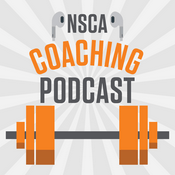
This is the NSCA’s Coaching Podcast, where strength and conditioning coaches share their experience, lessons learned, and advice about how to thrive in a highly competitive profession. Published by the National Strength and Conditioning Association, www.nsca.com.
Sítio Web de podcast

Ouve NSCA’s Coaching Podcast, Isso não é uma sessão de análise, com Vera Iaconelli e muitos outros podcasts de todo o mundo com a aplicação radio.pt

Obtenha a aplicação gratuita radio.pt

  • Guardar rádios e podcasts favoritos
  • Transmissão via Wi-Fi ou Bluetooth
  • Carplay & Android Audo compatìvel
  • E ainda mais funções

NSCA’s Coaching Podcast: Podcast do grupo

Informação legal
Aplicações
Social
v8.8.4| © 2007-2026 radio.de GmbH
Generated: 3/30/2026 - 5:12:18 AM