

Ouve este podcast gratuitamente na aplicação: Descarrega gratuitamente na App Store
radio.pt
Sleeptimer
Guardar rádio
157 episódios
Edible Empire: The Salmon and the Tomato
26/07/2026 | 50minThis is episode 4 of a six-part series on food imperialism. Welcome to Edible Empire, a podcast by Planet Pulse Pacific about the hidden cost of our food.
We celebrate flavours, but rarely the people behind them. This podcast uncovers how food—once shaped by empire and now by corporate power—has long been used to control land, labour, and cultures.
This episode explores the hidden links between salmon farming in northern Europe and tomato production in southern Spain, revealing the human and environmental costs behind cheap, year-round food.
What connects salmon farming in northern Europe with tomato farming in southern Spain? These two, seemingly distinct food supply chains ensure that our supermarket shelves are stocked with cheap, year-round food. What we don’t see, however, are the hidden links - the overfishing along the coast of West Africa that destroys local communities’ livelihoods and drives migration to Europe; the dangerous journeys by small boat where 1 in 5 people die; the entrapment of migrants arriving in exploitative agricultural labour in Spain’s intensive greenhouses. This episode examines the story of salmon farming and tomato greenhouses - and highlights the hidden costs of commodified food.
This episode uncovers the destructive and interconnected global supply chains linking northern European salmon aquaculture to southern Spanish greenhouse agriculture. Through interviews with four expert guests, the episode traces how the booming Norwegian salmon farming industry relies heavily on wild-caught ocean feed extracted from West Africa.
Investigative journalists Simen Sætre, Hazel Healy, and Brigitte Wear expose the ecological crises, corporate opacity, and false sustainability narratives surrounding aquaculture, whilst Dr Aliou Ba of Greenpeace Africa details how this industrial plundering has collapsed local artisanal fisheries and triggered a profound food security crisis in Senegal. This environmental degradation ultimately forces thousands of displaced West Africans to undertake a perilous sea voyage to Spain, where researcher María Alonso Martínez reveals they are heavily exploited as undocumented migrant labourers, working under inhumane conditions within Almería’s vast "Sea of Plastic" to harvest the cheap winter vegetables that stock European supermarket shelves.
Make sure you subscribe so you don’t miss out on the next episode!
Resources from this episode:
https://norla.no/en/books/1286-the-new-fish-the-global-history-of-salmon-farming
https://www.penguinrandomhouse.com/books/735421/the-new-fish-by-simen-saetre-and-kjetil-ostli/
To view all the links to the websites and documents, visit the show notes on our website.
Please support our work and enable us to deliver more content by buying us a coffee or becoming a member of Athletes for Nature.
Follow us on Instagram and Facebook, subscribe to this podcast, and share this episode with your friends and family.Edible Empire: Deep roots—a history of oil palm
19/07/2026 | 59minThis is episode 3 of a six-part series on food imperialism. Welcome to Edible Empire, a podcast by Planet Pulse Pacific about the hidden cost of our food.
Food isn’t just about taste—it’s power. This podcast explores how empires and corporations built control through agriculture, reshaping cultures and feeding some at the expense of others.
This episode traces the global impact of the palm oil industry from its indigenous roots to modern supply chains through three expert interviews.
Dr Jonathan Robins opens by detailing the pre-colonial history of oil palm in West Africa and explaining how European empires weaponised the crop to fuel the Industrial Revolution, establishing structural patterns that mirror today’s agribusiness models.
Dr Helena Varkkey then unpacks the political economy of Malaysian production, exposing how entrenched relationships between political elites and conglomerates shield the industry from regulation.
Farwiza Farhan brings a frontline conservation perspective from Indonesia, documenting how government-incentivised monoculture plantations drive deforestation, threaten endangered species, and violate Indigenous land rights.
Together, the experts critique the effectiveness of voluntary sustainability certification schemes like the RSPO, debate whether palm oil can ever be truly sustainable at scale, and highlight the efforts of local communities fighting back against corporate food imperialism.
Make sure you subscribe so you don’t miss out on the next episode!
Resources from this episode:
https://www.mtu.edu/social-sciences/department/faculty/robins/
https://commoditiesofempire.org.uk/about/jonathan-robins/
https://theconversation.com/profiles/jonathan-e-robins-1227071
https://seapeat.wixsite.com/home
https://cgsea.org/
https://umexpert.um.edu.my/helenav
To view all the links to the websites and documents, visit the show notes on our website.
Please support our work and enable us to deliver more content by buying us a coffee or becoming a member of Athletes for Nature.
Follow us on Instagram and Facebook, subscribe to this podcast, and share this episode with your friends and family.Edible Empire: Corporate power in the food system
12/07/2026 | 35minThis is episode 2 of a six-part series on food imperialism. Welcome to Edible Empire, a podcast by Planet Pulse Pacific about the hidden cost of our food.
Beyond recipes lies a story of power. From colonial plantations to modern agribusiness, this podcast reveals how the pursuit of food has redrawn maps, exploited people, and continues to shape who holds control today.
This episode explores how an increasingly monopolised system of multinational corporations operates as de facto states within the global food system, exercising power over land, labour, trade, and policy in ways that rival or exceed nation-states.
If empires once flew flags, today they file annual reports. This episode examines how large agrifood corporations increasingly function as sovereign actors within global food systems. From controlling vast transnational supply chains and shaping trade rules, to influencing national policy and disciplining labour across borders, corporations now wield powers historically associated with states. Focusing on agribusiness, food traders, and retailers, the episode asks how corporate concentration has reconfigured food imperialism, turning companies into the new “nations” of food empires, and what this means for accountability, democracy, and food sovereignty.
In this episode of Edible Empire, Professors Phil Howard and Jennifer Clapp unpack how intense corporate concentration has transformed global agriculture into a system dominated by a few powerful transnational firms that operate much like sovereign states. Using the analogy of an hourglass, Professor Phil Howard illustrates how millions of farmers and billions of consumers are squeezed through a dangerously narrow bottleneck controlled by these massive agribusinesses, which deploy specific power plays to manipulate trade rules, capture government subsidies, and avoid accountability for environmental and labour exploitation. Meanwhile, Professor Jennifer Clapp highlights how mega-mergers in the agricultural inputs sector allow a small cartel to exercise immense structural power, locking in an industrial model that dictates what society views as "normal" food practices, while trapping countries in the Global South in dependency loops that prioritise luxury exports over local food security. Despite the immense political and economic inertia behind this consolidation, both experts close with a message of hope, emphasising that because this extractive system was constructed by humans, it can be dismantled through active political engagement and collective action.
Make sure you subscribe so you don’t miss out on the next episode!
Resources from this episode:
https://philhoward.net/
https://ipes-food.org/people/phil-howard/
https://uwaterloo.ca/scholar/jclapp/home
https://ipes-food.org/people/jennifer-clapp/
https://uwaterloo.ca/environment-resources-and-sustainability/profiles/jennifer-clapp
To view all the links to the websites and documents, visit the show notes on our website.
Please support our work and enable us to deliver more content by buying us a coffee or becoming a member of Athletes for Nature.
Follow us on Instagram and Facebook, subscribe to this podcast, and share this episode with your friends and family.Edible Empire: What is food imperialism?
05/07/2026 | 37minThis is episode 1 of a six-part series on food imperialism. Welcome to Edible Empire, a podcast by Planet Pulse Pacific about the hidden cost of our food.
We celebrate flavours, but rarely the people behind them. This podcast uncovers how food—once shaped by empire and now by corporate power—has long been used to control land, labour, and cultures.
This episode explores how global food systems are shaped by historical power structures and capitalist mechanisms that prioritise corporate profit and "cheap food" over the health of ecosystems and human communities.
Where does our food come from? Who works in the fields that produce our fruit and vegetables? Who is making a profit from the food we eat? This episode sets the scene for the series, introducing the concept of food supply chains—the intricate trade routes that keep supermarket shelves stocked with produce all year round. But how did these global networks come to be? Tracing the history of our globalised food systems, we uncover why our food systems look the way they do today. Featuring Professors Harriet Friedmann and Raj Patel.
Professor Harriet Friedmann begins by tracing how global power shifted from a British-led system to one dominated by the US dollar. She explains that this change transformed how the world eats, replacing diverse, sustainable local farming with industrial monocultures like wheat and palm oil. This shift prioritised international profit over local cultures and environmental health.
Building on this history, Professor Raj Patel exposes the deception of "cheap" food. He argues that low prices are only possible by pushing the true costs onto the planet and underpaid workers. According to Patel, the global food system isn't broken; it is designed to make hunger profitable. He concludes with a call for food sovereignty, demanding we return power to the people who actually grow and harvest our food.
Make sure you subscribe so you don’t miss out on the next episode!
Resources from this episode:
https://harrietfriedmann.ca
https://www.researchgate.net/profile/Harriet-Friedmann
https://www.sociology.utoronto.ca/people/directories/all-faculty/harriet-friedmann
https://rajpatel.org/
https://www.antsandgrasshopper.org/
https://rajpatel.org/2009/10/27/stuffed-and-starved/
To view all the links to the websites and documents, visit the show notes on our website.
Please support our work and enable us to deliver more content by buying us a coffee or becoming a member of Athletes for Nature.
Follow us on Instagram and Facebook, subscribe to this podcast, and share this episode with your friends and family.Edible Empire: Prologue
28/06/2026 | 38minWelcome to Edible Empire - hosted by Planet Pulse Pacific, this is a podcast series about the hidden cost of our food. We’re your co-hosts, Neal Haddaway, Benjamin Eitelberg, and Emma Strutt, with Kelly Allum on editing.
When we talk about food, we tend to focus on recipes, flavours and dinner times. But what we rarely discuss is where our food comes from. And we don’t mean which supermarket - we mean the ingredients that make up our food: where did they come from, who grew the vegetables, picked the fruit and processed the oils? What’s life like for them, and what does their environment look like as a result of what they’re exporting for us to eat?
From the plantations of the British Empire to the smart agriculture within ultra-modern greenhouses, food has always been a tool of power and of profit. This is a story of how some cultures were dismantled to feed others, and how those empires live on through corporate control - this is a podcast about Food Imperialism. This series explores the complex, often uncomfortable intersection of appetite and authority. We are looking at food imperialism: how the quest for calories and commodities reshaped the map, redefined our identities, and continues to influence who gets to eat, and what, in the twenty-first century.
In this introductory episode, we introduce the concept of food imperialism and the inspiration for this species series. We discuss some of the upcoming content we’ll be publishing in the coming weeks, along with our exciting, world-leading expert guests.
Join us for an appetiser!
Make sure you subscribe so you don’t miss out on the next episode!
Resources from this episode:
https://www.thesalmonandthetomato.org
To view all the links to the websites and documents, visit the show notes on our website.
Please support our work and enable us to deliver more content by buying us a coffee or becoming a member of Athletes for Nature.
Follow us on Instagram and Facebook, subscribe to this podcast, and share this episode with your friends and family.
Mais podcasts de Ciência
 The Rest Is ScienceCiência, Filosofia, Física, Sociedade e cultura, Tecnologia
 Mais lento do que a luzCiência
 Ciência SujaCiência, Crimes verdadeiros, Documentário, Sociedade e cultura
 UnexplainableCiência, Ciências da Vida
 The Joy of WhyCiência, Ciências da Vida
 Ologies with Alie WardCiência, Comédia, Sociedade e cultura
 StarTalk RadioCiência, Ensino
 Consultório AmbientalCiência
 The Infinite Monkey CageCiência, Comédia
 Ciência PopCiência
Podcasts em tendência em Ciência
 Sidenote by AsapSCIENCECiência, Ciências da Vida, Comédia
 Climate ConnectionsCiência, Ciências Naturais, Notícias
 The Skeptics' Guide to the UniverseCiência
 Culpa do CérebroCiência
- The Infinite Monkey CageCiência, Comédia
 Inner Cosmos with David EaglemanCiência, Enriquecimento individual, Ensino, Saúde e fitness, Saúde mental
 Science QuicklyCiência
 Podcast de Juan Ramón RalloCiência, Ciências Sociais, Investimentos, Negócios, Notícias, Política
 Mystères et étoilesAstronomia, Ciência
 Psychiatry & Psychotherapy PodcastCiência, Medicina, Saúde e fitness
 New Books in Critical TheoryCiência, Ciências Sociais
 Café Ciência e FéCiência, Religião, Religião e espiritualidades
 Mind to MindCiência, Ciências Naturais
 Das Wissen | SWRCiência
 ZEIT WISSEN. Woher weißt Du das?Ciência, Ensino, Sociedade e cultura
Sobre Edible Empire
Planet Pulse Pacific—your go-to podcast for conversations about people and planet—is proud to host a special series: Edible Empire. As the climate and global health crises intensify, the need for meaningful change has never been more urgent. This six-episode series brings together leading voices from around the world to explore the concept of food imperialism, uncover the hidden social and environmental costs of what we eat, and examine how we can build a more just and sustainable food system. Join your hosts, Ben Eitelberg and Emma Strutt, alongside special series co-host Dr Neal Haddaway, as they dive into the complex and often unseen world of food—how it is produced, traded, and consumed across the globe. Kelly Allum edits the series.
Sítio Web de podcastOuve Edible Empire, The Rest Is Science e muitos outros podcasts de todo o mundo com a aplicação radio.pt
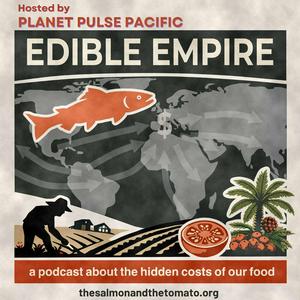
Obtenha a aplicação gratuita radio.pt
- Guardar rádios e podcasts favoritos
- Transmissão via Wi-Fi ou Bluetooth
- Carplay & Android Audo compatìvel
- E ainda mais funções
Obtenha a aplicação gratuita radio.pt
- Guardar rádios e podcasts favoritos
- Transmissão via Wi-Fi ou Bluetooth
- Carplay & Android Audo compatìvel
- E ainda mais funções

Edible Empire
Leia o código,
descarregue a aplicação,
ouça.
descarregue a aplicação,
ouça.
 Portugal