
Ouve este podcast gratuitamente na aplicação: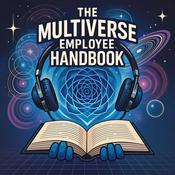 Descarrega gratuitamente na App Store
radio.pt
Sleeptimer
Guardar rádio
101 episódios
Wish You Were Here
12/05/2026 | 1minThe Multiverse Employee Handbook is taking a brief holiday. Our narrator is currently horizontal in a field outside Innsbruck, the Alps are doing their thing, and Season Four is being assembled somewhere in the quantum foam of late summer.
We'll be back soon — with more actual science, delivered with the calm urgency of someone who has just realised the atoms in their deckchair were forged inside a dying star.
Season Four arrives at the end of summer. Try not to collapse your wave function while we're gone.
AI Transparency: In a universe increasingly filled with AI-generated content, we believe in being clear about what’s human and what’s not. Your time is valuable, and you deserve to know what you’re experiencing.
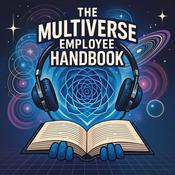
The narrator, David, is a professional voice actor who has digitized his voice using ElevenLabs’ voice-cloning technology and is fairly compensated for his vocal performance. Thumbnails are created using OpenArt, and sound effects come from Pixabay which are generated by human artists.
Everything else—the research, the writing, jokes, music, sound editing, and interdimensional coffee consumption—is 100% human-made by humans.Season 4 Trailer - The Multiverse Employee Handbook
07/04/2026 | 2minSeason 4 is Coming: The Universe Remains Uncooperative
The Multiverse Employee Handbook returns for a fourth season of science, satire, and the quiet suspicion that reality was written by a committee with no editorial oversight.
Season 4 dives deeper into the genuine absurdities of existence—the kind that come with equations, experimental evidence, and the occasional Nobel Prize. We'll be exploring everything from the arrow of time to the nuclear physics happening inside your own body, from dark energy's relentless campaign to stretch the cosmos into nothingness, to the uncomfortable probability that none of this is real and the simulation is running low on memory.
All of it accurate. All of it researched. All of it delivered with the calm, measured tone of someone explaining that the floor beneath you is mostly empty space and always has been.
Meanwhile, at Quantum Improbability Solutions, the Square-Haired Boss remains employed—a fact that challenges our understanding of natural selection, corporate governance, and the second law of thermodynamics in equal measure.
New episodes arriving soon. Subscribe now, while the concept of "soon" still means something in your local spacetime.
The Multiverse Employee Handbook. Revealing that science has been funny all along, and someone really should have mentioned it earlier.
AI Transparency: In a universe increasingly filled with AI-generated content, we believe in being clear about what’s human and what’s not. Your time is valuable, and you deserve to know what you’re experiencing.
The narrator, David, is a professional voice actor who has digitized his voice using ElevenLabs’ voice-cloning technology and is fairly compensated for his vocal performance. Thumbnails are created using OpenArt, and sound effects come from Pixabay which are generated by human artists.
Everything else—the research, the writing, jokes, music, sound editing, and interdimensional coffee consumption—is 100% human-made by humans.Is Space Trying to Kill Us? (Radiation)
31/03/2026 | 34minSpace radiation is constant, omnidirectional, and entirely unbothered by your feelings about it.
🎧 Love the show? Help us improve in 2 minutes: https://tally.so/r/nr1evM
This week: what's actually out there, why Earth has been quietly protecting us for four billion years without asking for credit, and what happens when you leave that protection behind. Exploding stars, Van Allen's doughnuts, the surprisingly violent history of how we first noticed, and why the most sophisticated radiation shielding strategy currently available is, in certain respects, a cave. Plus: NASA's Artemis programme is heading back into deep space for the first time in fifty years, and this time we're bringing considerably better instruments.
AI Transparency: In a universe increasingly filled with AI-generated content, we believe in being clear about what’s human and what’s not. Your time is valuable, and you deserve to know what you’re experiencing.
The narrator, David, is a professional voice actor who has digitized his voice using ElevenLabs’ voice-cloning technology and is fairly compensated for his vocal performance. Thumbnails are created using OpenArt, and sound effects come from Pixabay which are generated by human artists.
Everything else—the research, the writing, jokes, music, sound editing, and interdimensional coffee consumption—is 100% human-made by humans.
https://multiverseemployeehandbook.comOur Other Nearest Neighbours
24/03/2026 | 29minHumanity has spent thousands of years naming constellations, building calendars, and writing mythology onto the night sky — largely ignoring the actual stars next door.
🎧 Love the show? Help us improve in 2 minutes: https://tally.so/r/nr1evM
This week, we meet the ten nearest star systems to Earth: a collection of failed stars, violent flare stars, one object colder than a freezer, and a sales territory that Brad from Quantum Improbability Solutions would like formally struck from the Q4 quota. Space is stranger than advertised. The neighbourhood association has concerns.
AI Transparency: In a universe increasingly filled with AI-generated content, we believe in being clear about what’s human and what’s not. Your time is valuable, and you deserve to know what you’re experiencing.
The narrator, David, is a professional voice actor who has digitized his voice using ElevenLabs’ voice-cloning technology and is fairly compensated for his vocal performance. Thumbnails are created using OpenArt, and sound effects come from Pixabay.
Everything else—the research, the writing, jokes, music, sound editing, and interdimensional coffee consumption—is 100% human-made by a human.
https://multiverseemployeehandbook.comIs Tau Ceti Our Project Hail Mary?
17/03/2026 | 33minEleven point nine light-years away, in the constellation of a mythological sea monster, sits a star that astronomers, SETI researchers, and science fiction writers have been collectively obsessed with since 1960.
🎧 Love the show? Help us improve in 2 minutes: https://tally.so/r/nr1evM
In this episode of The Multiverse Employee Handbook, we visit Tau Ceti — the Sun-like neighbour that has everything you'd want in a nearby stellar system: stability, age, a habitable zone, and almost certainly planets. Almost certainly. We explore the full and rather remarkable story of this ancient star, from Johann Bayer's 1603 star atlas and Frank Drake's original SETI search, through decades of planet hunting, a debris disk of genuinely alarming proportions, and the latest findings from the ESPRESSO spectrograph, which has made everything considerably more complicated. We also ask whether Tau Ceti represents a genuine opportunity for life beyond our Solar System — and why, despite everything, it refuses to stop being interesting. Plus: Ryan Gosling, the Kobayashi Maru, and the nine-billion-year question the universe is still sitting on.
Peer-reviewed papers
Refining the Stellar Parameters of τ Ceti (2023) — https://arxiv.org/abs/2307.10394
Integrated Analysis of the Tau Ceti Planetary System (2020) — https://arxiv.org/abs/2010.14675
Debris Disk of τ Ceti — Herschel Observations — https://arxiv.org/abs/1408.2791
AI Transparency: In a universe increasingly filled with AI-generated content, we believe in being clear about what’s human and what’s not. Your time is valuable, and you deserve to know what you’re experiencing.
The narrator, David, is a professional voice actor who has digitized his voice using ElevenLabs’ voice-cloning technology and is fairly compensated for his vocal performance. Thumbnails are created using OpenArt, and music and sound effects come from Pixabay.
Everything else—the research, the writing, jokes, sound editing, and interdimensional coffee consumption—is 100% human-made by a human.
https://multiverseemployeehandbook.com
Mais podcasts de Ciência






Podcasts em tendência em Ciência









Sobre The Multiverse Employee Handbook
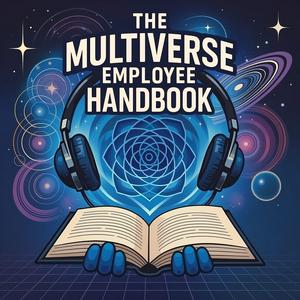
The Multiverse Employee Handbook is a science comedy podcast where workplace humor meets cosmic exploration. From quantum mechanics explained through staff meetings to space history through annual reviews, we decode scientific mysteries through corporate metaphors. Each episode combines rigorous science with absurdist office scenarios, whether exploring the strange physics of black holes or the equally baffling logic of expense reports. Perfect for curious minds who suspect their workplace might exist across multiple dimensions, we deliver astronomical insights wrapped in corporate satire. Whether you’re fascinated by the mysteries of dark matter or the inexplicable disappearance of break room snacks, our show provides genuine scientific knowledge with existential humor. Subscribe now to navigate both the cosmos and cubicle culture with equal parts wonder and skepticism! New episodes arrive every Tuesday, regardless of temporal anomalies.
Sítio Web de podcastOuve The Multiverse Employee Handbook, StarTalk with Neil deGrasse Tyson e muitos outros podcasts de todo o mundo com a aplicação radio.pt
Obtenha a aplicação gratuita radio.pt
- Guardar rádios e podcasts favoritos
- Transmissão via Wi-Fi ou Bluetooth
- Carplay & Android Audo compatìvel
- E ainda mais funções
Obtenha a aplicação gratuita radio.pt
- Guardar rádios e podcasts favoritos
- Transmissão via Wi-Fi ou Bluetooth
- Carplay & Android Audo compatìvel
- E ainda mais funções
The Multiverse Employee Handbook
Leia o código,
descarregue a aplicação,
ouça.
descarregue a aplicação,
ouça.
The Multiverse Employee Handbook: Podcast do grupo
 Portugal