
Ouve este podcast gratuitamente na aplicação: Descarrega gratuitamente na App Store
radio.pt
Sleeptimer
Guardar rádio
724 episódios
Why Are You In Sales? - Sales Influence Podcast #SIP 642
26/10/2026 | 7minCore Motivation Framework
A big enough why serves as the fundamental determinant of success or failure in sales, providing the psychological fuel to push through daily rejection and uncertainty that defines the profession.
Tangible, hardcore reasons for being in sales—such as financial security for family or affording specific things—create concrete fuel for motivation that sustains performance during periods when sales are down and numbers aren't being hit.
Strategic Communication
Clearly understanding and communicating your why to your spouse enables them to actively support your goals and dreams, creating alignment between personal ambition and family dynamics.
Practical Implementation
Writing down reasons for being in sales and engaging in deep reflection helps identify a sufficiently powerful why that will always fuel the how to achieve goals, establishing a direct causal relationship between purpose and execution.
Motivational Hierarchy
Financial freedom, controlling one's own destiny, and affording dreams and opportunities function as powerful motivators that transcend simple monetary gain, providing resilience when deals fall through and performance metrics decline.Quantify Your Sales Goal - Sales Influence Podcast #SIP 641
24/10/2026 | 7minAchieving professional aspirations requires transforming vague ambitions into tangible numerical targets rather than relying solely on wishful thinking. Sales professionals must calculate exact requirements by breaking large financial objectives down into manageable yearly, monthly, weekly, and daily quotas. This process helps adjust daily sales behaviors by defining the precise number of client meetings and phone calls needed to succeed. Furthermore, maintaining accountability is crucial, and individuals are significantly more likely to follow through when they share their plans with respected peers. Ultimately, success relies on combining this disciplined mathematical approach with a strong commitment to continuous self-improvement and client service.Avoiding the Friend Zone in Sales | #642
24/10/2026 | 7minAvoiding the Sales Friend Zone! Yeah, there's actually a friend zone when it comes to sales. You've visited the client five, ten times... and still no deal. Here's how to know if you're stuck in it. A client told me one of their biggest issues was salespeople who had "fallen into the friend zone with clients." In this Sales Influence Moment, I break down the five signals that a prospect likes you but isn't planning to buy, and what to do once you know. Key takeaways: - The 5 signs you're in the sales friend zone: it's always one-on-one, they won't introduce you to anyone else, business talk keeps getting pushed to "next quarter," you can't present to the committee or decision-makers, and they won't share budget or who they currently buy from. - Don't "choose to see what you want to see." Read the signals. - You've earned the right to ask: "Am I in the friend zone?" - If you're not number one, position yourself as number two, because eventually number one will falter. Then ask for a little bit of the business. - When they say they're happy with their current vendor, ask: "Isn't it always good to have options?" - Stay friends, but prioritize your pipeline accordingly. Chapters: 0:00 The friend zone in sales 0:29 What the friend zone is 1:04 Three types of people in the friend zone 1:59 Five, ten visits and no deal 2:17 5 ways to know you're in the sales friend zone 4:51 Why you want to know 5:43 Position yourself as number two 6:05 "Isn't it always good to have options?" 6:37 Prioritize your pipeline 7:05 Wrap-up and Priced to Win Want more on selling and negotiating? Check out VictorAntonio.com. #Sales #SalesTips #SalesTraining #B2BSales #VictorAntonio sales friend zone, avoiding the sales friend zone, friend zone, sales tips, sales training, B2B sales, sales pipeline, pipeline management, prospecting, sales objections, happy with current supplier, decision makers, sales strategy, selling tips, how to close more deals, stalled deals, sales influence, Victor Antonio, Priced to Win, sales motivationThe ONE Question That Puts You Back in Control of Any Sales Conversation | SIP #641
23/10/2026 | 7minIf you're explaining yourself, you're not winning the conversation. When a customer says "you're too expensive," the worst thing you can do is defend your price. Ask this one question instead. In this video, I share one of the most powerful questions in selling: "What makes you say that?" When a customer challenges you and you start explaining (quality, 24/7 service, your people), they just sit in judgment. I've never once heard a customer say, "Oh, that's why you're expensive." Asking "What makes you say that?" turns it around, so now they have to explain where their assumption came from. I'll walk you through a real example from a client who sells radio and TV advertising. A customer tells them, "radio is dead." I show how two questions, "What makes you say that?" and "Compared to what?", expose that assumption and move the conversation from eyeballs and dollars to conversion rates and average deal size. 🔑 Key Takeaways: • If you're explaining yourself, you're not winning the conversation. • Don't defend an objection. Ask "What makes you say that?" • Many objections are assumptions with no foundation. If you try to answer them, you'll lose the argument. • Ask "Compared to what?" to reframe price objections. • Move the comparison from quantity (how many people see or hear the ad) to conversion rates and average deal size. • Sales is not about talking a lot. It's mental jiu-jitsu. • When the customer stumbles, that's your chance to educate them, position yourself as the expert and earn their trust. Selling ain't hard when you ask great questions and you know how. 📘 Tired of hearing "your price is too high"? My new book, *Priced to Win* (Wiley), comes out November 9. 👉 Visit https://victorantonio.com for training, keynotes, and more. 🔔 Subscribe for more sales strategies every week: https://youtube.com/victorantoniolive #SalesTips #SalesTraining #ObjectionHandling #PriceObjections #SalesQuestions #VictorAntonio #PricedToWinDark Days of Selling - Sales Influence Podcast #SIP 640
18/10/2026 | 9minMental State Management
Attitude drives behavior, which drives consequence—shifting your state by reviewing written sales goals and taking immediate action creates different outcomes, while a negative attitude results in zero action and zero achievement.
Walking while listening to a podcast serves as a secret formula to break mental barriers during sales funks by combining physical movement with mindset-shifting content.
Goal-Focused Execution
Obstacles only become visible when you take your eyes off the long-term goal—maintaining focus on quantified sales targets provides clarity that separates successful salespeople from the rest during dark days when deals don't close.
Recovery Protocol
Writing down tangible sales goals and quantifying the steps to achieve them creates evidence that reminds you why you do what you do, especially during periods when expected deals fail to materialize.
When experiencing a sales funk, force yourself to consume content (podcast, book, or video) to trigger a mindset shift that generates different behaviors and strategies, rather than remaining stuck in inaction.
Mais podcasts de Empreendedorismo








Podcasts em tendência em Empreendedorismo








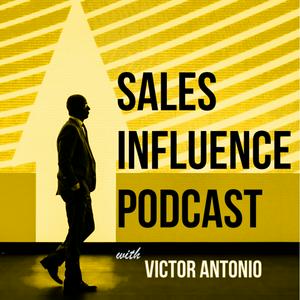
Sobre Sales Influence Podcast
Today's buyer is more informed and more skeptical when it comes to buying. In this podcast, we'll discuss "Finding the Why in How Clients Buy" by using the latest studies in consumer behavior and neuromarketing to sell more effectively!
Sítio Web de podcastOuve Sales Influence Podcast, THE FOUNDERS PODCAST e muitos outros podcasts de todo o mundo com a aplicação radio.pt
Obtenha a aplicação gratuita radio.pt
- Guardar rádios e podcasts favoritos
- Transmissão via Wi-Fi ou Bluetooth
- Carplay & Android Audo compatìvel
- E ainda mais funções
Obtenha a aplicação gratuita radio.pt
- Guardar rádios e podcasts favoritos
- Transmissão via Wi-Fi ou Bluetooth
- Carplay & Android Audo compatìvel
- E ainda mais funções
Sales Influence Podcast
Leia o código,
descarregue a aplicação,
ouça.
descarregue a aplicação,
ouça.
Sales Influence Podcast: Podcast do grupo
 Portugal

