
Ouve este podcast gratuitamente na aplicação: Descarrega gratuitamente na App Store
radio.pt
Sleeptimer
Guardar rádio
13 episódios
Why Do Continents Move?
11/07/2026 | 4minThe ground beneath your feet feels completely still... but the continents are actually moving all the time.
In this episode of Why Though?, Dr Matt Agnew explains why continents drift across the Earth, how tectonic plates slowly carry them around the planet, and how that movement creates mountains, deep ocean trenches and earthquakes.
What you'll discover:
Continents move just a few centimetres each year... about as fast as your fingernails grow
Long ago, every continent was joined together in one giant supercontinent called Pangaea
Earth's crust is made of enormous tectonic plates rather than one solid shell
When plates collide they can push up mountain ranges like the Himalayas
When one plate slides underneath another, it creates deep ocean trenches through a process called subduction
Earthquakes happen when pressure builds between stuck plates before suddenly being released
Why Though? The show for little scientists who love asking big questions. Subscribe so you never miss an episode.
Also available on Spotify and Apple Podcasts... search Why Though?
Follow Dr Matt Agnew:
Instagram: instagram.com/drmattagnew
TikTok: tiktok.com/@drmattagnew
YouTube: youtube.com/@whythoughpod
Website: drmattagnew.com
Find Why Though? podcast across the internet and share with your friends!
Instagram: instagram.com/whythoughpod
TikTok: tiktok.com/@whythoughpod
Facebook: facebook.com/whythoughpod
#whythough #scienceforkids #kidspodcast #dryice #sublimation #DrMattAgnew #STEMforkids #kidsscience #educationalpodcast #Australiakids #curiouskids #chemistryforkids #familypodcast #statesofmatter #sciencefacts
Hosted on Acast. See acast.com/privacy for more information.What Is Dry Ice and Why Does It Make Fog?
04/07/2026 | 3minIt looks like magic. It makes spooky fog that pours down instead of floating up. And it never leaves a puddle. So what is dry ice actually doing?
Dr Matt Agnew unpacks the weird science of dry ice, what sublimation is, why the fog pours downward like a waterfall, and why dry ice behaves so completely differently from the ice in your freezer.
What you'll learn:
Normal ice is frozen water... dry ice is frozen carbon dioxide, the gas we breathe out
Dry ice skips the liquid step entirely... straight from solid to gas with no puddle
Scientists call that process sublimation, one of the most interesting phase changes in science
The fog is mostly not carbon dioxide at all... it's water vapour from the surrounding air getting chilled so fast it becomes visible
Cold air and carbon dioxide are both heavier than regular warm air, so the fog pours downward like a fog waterfall
Dry ice is essentially a natural fog machine used in theatres, film sets and Halloween displays worldwide
Key Science Ideas:
Sublimation: When a solid skips the liquid stage and goes straight to gas
Carbon dioxide: The gas we breathe out, and what dry ice is made of
Water vapour: Invisible water in the air that becomes visible when it gets suddenly cold
Phase change: When matter moves between solid, liquid and gas states
Density: Why cold air and carbon dioxide both sink rather than rise
Safety note: Dry ice is extremely cold and must only be handled by adults wearing insulated gloves. It should only be used in well ventilated spaces. This is a watch and learn episode.
Why Though? The show for little scientists who love asking big questions. Follow or subscribe so you never miss an episode.
Follow Dr Matt Agnew:
Instagram: instagram.com/drmattagnew
TikTok: tiktok.com/@drmattagnew
YouTube: youtube.com/@whythoughpod
Website: drmattagnew.com
Find Why Though? podcast across the internet and share with your friends!
Instagram: instagram.com/whythoughpod
TikTok: tiktok.com/@whythoughpod
Facebook: facebook.com/whythoughpod
Hosted on Acast. See acast.com/privacy for more information.What's the Fastest Thing on Earth?
27/06/2026 | 4minA cheetah? A race car? A rocket? All great guesses. All completely wrong. The fastest thing on Earth is something you can't hold in your hand... and understanding it means understanding lightyears, the speed of light, and why space distances break normal numbers.
Dr Matt Agnew runs the ultimate speed race from Usain Bolt all the way to the speed of light, and explains what a lightyear actually is along the way. Spoiler... most adults get it wrong.
What you'll learn:
Usain Bolt tops out at around 44 kilometres per hour... the slowest in this race by a long way
A cheetah sprints at 100 to 120 kilometres per hour... basically a furry rocket
An F1 car reaches around 350 kilometres per hour... blink and it's gone
NASA's Parker Solar Probe is the fastest human-made object at 690,000 kilometres per hour
Light travels so fast it feels instant... and in one second it can circle the entire Earth about seven times
A lightyear isn't time, it's distance... how far light travels in one whole year, about 9.5 trillion kilometres
The closest star to Earth after our Sun is Proxima Centauri, just 4.2 lightyears away
Key Science Ideas:
Speed of light: About 300,000 kilometres per second... the ultimate speed limit of the universe
Lightyear: A unit of distance, not time... how far light travels in one whole year
Proxima Centauri: The closest star to Earth after our Sun, 4.2 lightyears away
Parker Solar Probe: NASA's spacecraft and the fastest human-made object ever built
Astronomical scale: Why scientists need special units like lightyears to measure enormous distances in space
Fun Experiment: The Lightyear Myth Buster
Ask three people in your house or school what a lightyear is. Most will say it's a unit of time. They're wrong... it's distance. Explain that a lightyear is how far light travels in one year, about 9.5 trillion kilometres. You've just done your first myth-busting science experiment, and you didn't need a single piece of equipment.
Why Though? The show for little scientists who love asking big questions. Follow or subscribe so you never miss an episode.
Why Though? The show for little scientists who love asking big questions. Follow or subscribe so you never miss an episode.
Follow Dr Matt Agnew:
Instagram: instagram.com/drmattagnew
TikTok: tiktok.com/@drmattagnew
YouTube: youtube.com/@whythoughpod
Website: drmattagnew.com
Find Why Though? podcast across the internet and share with your friends!
Instagram: instagram.com/whythoughpod
TikTok: tiktok.com/@whythoughpod
Facebook: facebook.com/whythoughpod
Hosted on Acast. See acast.com/privacy for more information.Why Does Looking at the Sun Make Some People Sneeze?
20/06/2026 | 4minHave you ever walked outside on a bright sunny day and suddenly sneezed... with no dust, no pepper, no cat fluff anywhere? Just sunshine and a sneeze? There's a real science reason behind it.
Dr Matt Agnew investigates the sun sneeze mystery. What even is a sneeze? Why does bright light trigger one for some people? And why does it run in families?
What you'll learn:
Sneezing is your body's nose cleaning button... a blast of air that clears anything annoying from your mucous membrane
When bright sunlight hits your eyes, your brain urgently signals blink and squint
For about 1 in 4 people, the blink button and the sneeze button sit really close together in the brain... so pressing one accidentally bumps the other
Scientists call this ACHOO Syndrome... short for Autosomal Dominant Compelling Helio-Ophthalmic Outburst
Sun sneezing is linked to your genes, which means it can run in families
Sun sneezes won't hurt you... but stop before the sneeze hits if you're on a bike or crossing the road
Key Science Ideas:
Mucous membrane: The sticky lining inside your nose that catches dust, germs and anything annoying
Optic nerve: The nerve that carries signals from your eyes to your brain
ACHOO Syndrome: The scientific name for sun sneezing... and yes, the acronym was absolutely intentional
Genes: The instructions inside your body that decide things like eye colour, height, and apparently whether sunshine makes you sneeze
Reflex: An automatic body response your brain triggers without you choosing it
Fun Experiment: The Family Sun Sneeze Survey Ask everyone in your family whether they sneeze when they look at bright light. Try a torch in a dark room if the sun isn't cooperating. Keep track of who does and who doesn't. If sun sneezing runs in your family, you'll start to see a pattern... and you'll have just conducted your first genetics experiment at the kitchen table.
Why Though? The show for little scientists who love asking big questions. Follow or subscribe so you never miss an episode.
Follow Dr Matt Agnew:
Instagram: instagram.com/drmattagnew
TikTok: tiktok.com/@drmattagnew
YouTube: youtube.com/@whythoughpod
Website: drmattagnew.com
Find Why Though? podcast across the internet and share with your friends!
Instagram: instagram.com/whythoughpod
TikTok: tiktok.com/@whythoughpod
Facebook: facebook.com/whythoughpod
Hosted on Acast. See acast.com/privacy for more information.Why Are Farts Smelly?
13/06/2026 | 4minHere's something nobody tells you. Most of a fart has absolutely no smell. So what's actually making everyone pinch their nose?
Dr Matt Agnew investigates the science of farts. How do smells actually work? What is a fart made of? And why do some foods make the whole situation so much worse?
What you'll learn:
Smells are tiny invisible particles floating in the air that your olfactory receptors grab and send to your brain
A fart is gas made by bacteria in your intestines while they break down food
Most fart gas has absolutely no smell... nitrogen, hydrogen, carbon dioxide, oxygen and even methane are all odourless
The real culprit is hydrogen sulfide... just 1% of a fart but enough to clear a room
Foods like beans, eggs, broccoli, brussels sprouts, garlic, onion and cheese all produce more hydrogen sulfide
Most people fart between 10 and 20 times a day... farts are natural, healthy, and a sign your body is doing its job
Astronauts on the International Space Station have to think carefully about farts because the gas can be trapped and even flammable
Key Science Ideas:
Olfactory receptors: The tiny parts inside your nose that detect smell and send signals to your brain
Bacteria: Tiny living things in your intestines that help break down food... and make gas while doing it
Hydrogen sulfide: The gas responsible for that rotten egg smell... and basically every bad fart ever
Intestines: The long tube where food gets broken down after leaving your stomach
Microbiome: The community of bacteria living inside your body doing useful work every day
Fun Experiment: The Food Fart Tracker Pick two days this week. On day one eat a meal with plenty of broccoli, beans or eggs. On day two eat a meal without any of those. Pay attention to what happens a few hours after each meal. That difference is hydrogen sulfide in action... your gut bacteria working harder on certain foods and producing more of that one very specific gas. Science is everywhere, even when you'd rather it wasn't.
Why Though? The show for little scientists who love asking big questions. Follow or subscribe so you never miss an episode.
Follow Dr Matt Agnew:
Instagram: instagram.com/drmattagnew
TikTok: tiktok.com/@drmattagnew
YouTube: youtube.com/@whythoughpod
Website: drmattagnew.com
Find Why Though? podcast across the internet and share with your friends!
Instagram: instagram.com/whythoughpod
TikTok: tiktok.com/@whythoughpod
Facebook: facebook.com/whythoughpod
Hosted on Acast. See acast.com/privacy for more information.
Mais podcasts de Ciência







Podcasts em tendência em Ciência
















Sobre Why Though? with Dr. Matt Agnew
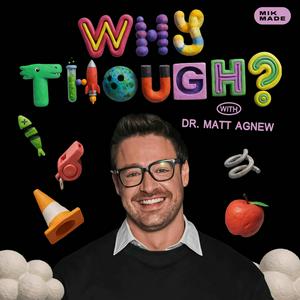
Hosted by scientist Dr Matt Agnew, Why Though? is Australia's new science podcast for curious kids aged 8–12.Every episode starts with one question kids actually ask... and ends with a science adventure. Real answers, weird facts, and the kind of stuff that makes you look at the world differently on the walk home from school.Perfect for car trips, classrooms, and kids who can't stop asking why.Why Though? The show for little scientists who love asking big questions. Follow or subscribe now so you don't miss Episode One. Hosted on Acast. See acast.com/privacy for more information.
Sítio Web de podcastOuve Why Though? with Dr. Matt Agnew, StarTalk with Neil deGrasse Tyson e muitos outros podcasts de todo o mundo com a aplicação radio.pt
Obtenha a aplicação gratuita radio.pt
- Guardar rádios e podcasts favoritos
- Transmissão via Wi-Fi ou Bluetooth
- Carplay & Android Audo compatìvel
- E ainda mais funções
Obtenha a aplicação gratuita radio.pt
- Guardar rádios e podcasts favoritos
- Transmissão via Wi-Fi ou Bluetooth
- Carplay & Android Audo compatìvel
- E ainda mais funções

Why Though? with Dr. Matt Agnew
Leia o código,
descarregue a aplicação,
ouça.
descarregue a aplicação,
ouça.
 Portugal

