
Ouve este podcast gratuitamente na aplicação: Descarrega gratuitamente na App Store
radio.pt
Sleeptimer
Guardar rádio
4 episódios
Is our phone the most dangerous drug we use every day?
06/10/2026 | 58minSocial media can connect us, inform us and entertain us. But it can also keep us scrolling, expose us to misinformation and shape how we see ourselves and the world around us. So how do we build a healthier relationship with our digital lives?
In this episode of Health Reality Check, host Dr Margarida Santos speaks with Professor Sander van der Linden, a social psychologist and leading expert on misinformation, about how digital environments influence our behaviour and beliefs. They explore the impact of social media on young people and how platforms could be designed with safety in mind.
They also look at why misinformation is so persuasive, how “prebunking” can help us recognize manipulation before we encounter it, and why curiosity, nuance and an open mind may be some of our best defences online.
The host and external guests participate in Health Reality Check as independent contributors. Their participation does not imply WHO support for all their views, opinions or activities.
Show notes / links
WHO resources
• WHO/Europe: A focus on adolescent social media use and gaming in Europe, central Asia and Canada, Health Behaviour in School-aged Children (HBSC) international report, 2021/2022 survey, Volume 6
• WHO/Europe: Teens, screens and mental health
• WHO/Europe: Addressing the digital determinants of youth mental health and well-being
• WHO/Europe: A focus on adolescent peer violence and bullying in Europe, central Asia and Canada, Health Behaviour in School-aged Children (HBSC) international report, 2021/2022 survey, Volume 2
• WHO/Europe: Infodemic management
Research discussed in the episode
• van der Linden S. Misinformation: susceptibility, spread, and interventions to immunize the public. Nature Medicine, 2022.
• Roozenbeek J, van der Linden S, Goldberg B, Rathje S, Lewandowsky S. Psychological inoculation improves resilience against misinformation on social media. Science Advances, 2022.
• Paluck EL, Shepherd H, Aronow PM. Changing climates of conflict: A social network experiment in 56 schools. Proceedings of the National Academy of Sciences, 2016.
• Allcott H, Braghieri L, Eichmeyer S, Gentzkow M. The Welfare Effects of Social Media. American Economic Review, 2020.Who Really Keeps Us Healthy?
15/09/2026 | 41minIs staying healthy simply a matter of making the right choices? Or are those choices shaped long before we make them?
In this episode of Health Reality Check, host Dr Margarida Santos sits down with Gundo Weiler, former Director of Prevention and Health Promotion at WHO/Europe, and Allison Ekberg, Technical Officer for Noncommunicable Diseases at WHO/Europe, to unpack what prevention really means.
From bike lanes and healthier food to taxes, regulation and the information we see online, they explore how the environments around us shape our health, why prevention is often invisible when it works, and what governments, communities and individuals can do to make healthy choices easier.
Show notes / links
· WHO Constitution: What does WHO mean by “health”? Constitution of the World Health Organization
· WHO/Europe: NCD Quick Buys NCD quick buys - 25 interventions delivering public health impact in five years or less
· United Kingdom: Sugar reduction and reformulation Sugar reduction in drinks: 2015 to 2024 - GOV.UK
· Health Reality Check: Who can we trust for health information? with Dr Mike Varshavski https://www.youtube.com/watch?v=1CtVMH3IUVc&t
· Ottawa Charter for Health Promotion Ottawa charter for health promotion
· WHO European Healthy Cities Network WHO European Healthy Cities NetworkWho can we trust for health information?
01/09/2026 | 24minMillions of people get health information from social media. But how do you tell credible information from viral misinformation? Why do myths spread so quickly online? And what makes people trust one voice over another?
In this episode of Health Reality Check, host Dr Margarida Santos sits down with Dr Mike Varshavski, family physician and one of the world's most-followed health creators, for a conversation about navigating health information in the digital age. Together they explore how to communicate evidence without losing people's attention, the responsibility that comes with influence, and how curiosity can be a powerful antidote to false information.
The host and external guests participate in Health Reality Check as independent contributors. Their participation does not imply WHO support for all their views, opinions or activities.
Show notes / links
WHO Regional Office for Europe: https://www.who.int/europe
WHO – What we do: https://www.who.int/about/what-we-do
Mike’s TED talk in Monte Carlo: The epidemic of the "I Know All" expert | Mikhail (Doctor Mike) Varshavski | TEDxMonteCarloWhat does the World Health Organization actually do?
10/08/2026 | 31minMany people know WHO from global emergencies like COVID-19. But what does the World Health Organization actually do the rest of the time? How does WHO develop health recommendations ? Does WHO tell countries what to do? And why does trust matter more than ever?
In this special launch episode of Health Reality Check, host Dr Margarida Santos sits down with Dr Hans Kluge, WHO Regional Director for Europe, for a candid conversation about how WHO works behind the scenes, how science becomes public policy, why prevention is often invisible when it succeeds, and the biggest health challenges facing Europe today.
---
Health Reality Check is a podcast from the World Health Organization that goes beyond the headlines to explore what the evidence says about today’s biggest health questions. Hosted by family doctor Dr Margarida Santos, each episode brings together leading experts and professionals public health for clear answers to complex questions. From nutrition and cancer to digital health and health inequalities, we put health claims under the microscope. Whether you're making decisions about your own health or trying to make sense of today’s health debates, Health Reality Check gives you the evidence behind the headlines.
---
Show notes/links
WHO Regional Office for Europe: https://www.who.int/europe
Heat-health action plans: https://www.who.int/europe/health-topics/climate-change-and-health/heat-and-health
Second European Programme of Work (EPW2): https://www.who.int/europe/about-us/our-work/second-european-programme-of-work-2026-2030
WHO – what we do? https://www.who.int/about/what-we-do/
No level of alcohol consumption is safe for our health: No level of alcohol consumption is safe for our health
Mental Health of doctors and nurses https://www.who.int/europe/publications/i/item/WHO-EURO-2025-12709-52483-81031
Global Status report on cancer 2026: https://www.who.int/publications/i/item/9789240123977
Mais podcasts de Saúde e fitness



Podcasts em tendência em Saúde e fitness






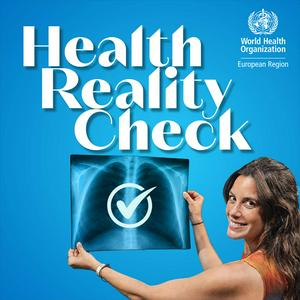
Sobre Health Reality Check
Health Reality Check is the podcast from the World Health Organization that goes beyond the headlines to explore what the evidence says about today’s biggest health questions. Hosted by family doctor Dr Margarida Santos, each episode brings together leading experts and professionals public health for clear answers to complex questions. From nutrition and cancer to digital health and health inequalities, we put health claims under the microscope. Whether you're making decisions about your own health or trying to make sense of today’s health debates, WHO's Health Reality Check gives you the evidence behind the headlines.
Sítio Web de podcastOuve Health Reality Check, Huberman Lab e muitos outros podcasts de todo o mundo com a aplicação radio.pt
Obtenha a aplicação gratuita radio.pt
- Guardar rádios e podcasts favoritos
- Transmissão via Wi-Fi ou Bluetooth
- Carplay & Android Audo compatìvel
- E ainda mais funções
Obtenha a aplicação gratuita radio.pt
- Guardar rádios e podcasts favoritos
- Transmissão via Wi-Fi ou Bluetooth
- Carplay & Android Audo compatìvel
- E ainda mais funções
Health Reality Check
Leia o código,
descarregue a aplicação,
ouça.
descarregue a aplicação,
ouça.
 Portugal

