
Ouve este podcast gratuitamente na aplicação: Descarrega gratuitamente na App Store
radio.pt
Sleeptimer
Guardar rádio
In Our Powers: The Holistic Self-defense Podcast
Carolyn Fallert | Self-Defense Coach & Writer
Último episódio
6 episódios
Trauma-Informed Care, From the Doctor’s Office to the Self-Defense Class with Beth Docherty
27/10/2026 | 47minIf you’ve ever wondered what “trauma-informed” truly means, or how to tell whether a space, provider, or a self-defense class is going to feel safe for you, this episode is for you.
I had the honor of sitting down with Beth Docherty, principal of The TRUST Project, a research and outreach initiative that educates healthcare professionals, students, and communities about trauma and its impact on health and well-being. A former research chemist, Beth combines scientific thinking with lived experience to advance trauma-informed practices and strengthen communities. I’ve gotten to know Beth over the past couple of years through our writing group with trauma-informed writing coach Lisa Cooper Ellison.
We talk about what it really means to be trauma-informed, why trauma is so common, and how shifting from “what’s wrong with you?” to “what might have happened to you?” can change the way we show up for one another. Beth walks through the six guiding principles of a trauma-informed approach from SAMHSA ( Substance Abuse and Mental Health Services Administration), starting with safety, and shares simple, concrete ways to create it, from explaining what’s about to happen before it happens to offering real choices.
I share a personal story about going through TSA screening and how my body responded, even after years of therapy. Together, we explore body memory and why trauma knows no time or place. We also discuss that when there's been trauma in the context of a relationship, healing happens in relationship, and not necessarily with that person who caused the harm, but in relationship with other people and finding safety with other people.
Beth and I also get practical about self-defense. We talk about how to tell whether a class is trauma-informed, the red flags to watch for (like surprise contact, teaching through shame, or pressure to share your story), and the question to ask an instructor before you sign up. We also talk about why everything in a workshop should be an invitation, why instructors should model checking in, and why you should never have to explain yourself to take a break.
We close with self-advocacy, including what it’s like to be labeled a “difficult patient” for listening to your own body, and Beth’s three tools for moments when a space doesn’t feel safe: trust yourself, advocate for yourself, and calm your nervous system. Her reminder that the goal is a toolbox of strategies, not one perfect fix, is one I’ll keep coming back to.
I hope you enjoy this conversation with Beth Docherty as much as I did. I’m still thinking about her reminder that every interaction we have can either reinforce trauma or promote healing, which means every one of us has more power than we realize to create safety for the people around us.
Enjoy the wisdom of Beth and this conversation about trauma-informed care, safety, choice, self-advocacy, and healing in relationship.
More about this episode’s guest:
Beth Docherty is the principal of The TRUST Project, a research and outreach initiative that educates healthcare professionals, students, and communities about trauma and its impact on health and well-being. A former research chemist, she combines scientific thinking with lived experience to advance trauma-informed practices and strengthen communities.
Beth is a member of the Physical and Behavioral Action Team of HEAL PA, helping implement trauma-informed care across Pennsylvania. She serves as co-chair of The Crime Victims Alliance of PA and Empowered Advocacy group, is a member of Resilient Voices, and serves on the Board of Directors for The PA Organization for Women in Early Recovery (POWER). Her previous leadership includes service with Pittsburgh Action Against Rape (PAAR), the Pennsylvania Coalition Against Rape (PCAR), and the Pennsylvania Association of Nonprofit Organizations (PANO). Beth has testified in judicial policy hearings and presents and speaks nationally about sexual abuse and trauma-informed care.
Links from Beth:
Website: TheTrustProject-pa.com
LinkedIn: www.linkedin.com/in/beth-docherty-trust
HuffPost essay: https://www.huffpost.com/entry/doctor-trauma-informed-health-care-septic_n_686af8dde4b0762f74e11c1e?eyo
PA Centered podcast interview: https://open.spotify.com/episode/5y8jeDZkbW36wJS3CVy6Xj?si=5199d2788a0d42bb
SAMHSA’s six guiding principles: https://www.samhsa.gov/resource/dbhis/infographic-6-guiding-principles-trauma-informed-approach
How Nature Nurtures: https://www.nature.com/articles/s41380-022-01720-6
Pittsburgh Parks Rx: https://pittsburghparks.org/parks-rx/
Brené Brown on empathy vs. sympathy: https://www.youtube.com/watch?v=KZBTYViDPlQ
Heal PA: https://healpa.org/
Pittsburgh Action Against Rape: https://paar.net/
Pennsylvania Association for Nonprofit Organizations: https://pano.org/
JAMA Op Ed: https://jamanetwork.com/journals/jama/article-abstract/2843896
Trauma-informed care statistics and sources (from Beth):
About 1 in 5 women in the U.S. will experience completed or attempted rape in their lifetime. Source: National Institute of Mental Health (NIMH), citing the National Center for PTSD and NISVS. https://www.nimh.nih.gov/health/statistics/post-traumatic-stress-disorder-ptsd
More than 12 million women and men in the U.S. experience rape, physical violence, or stalking by an intimate partner each year, which is more than 24 people every minute. Source: National Coalition Against Domestic Violence (NCADV), based on NISVS. https://ncadv.org/statistics
About 50% of adults will experience at least one traumatic event in their lifetime. Source: NIMH (link above).
About 6–7% of U.S. adults will develop PTSD in their lifetime, and women are about twice as likely as men. Source: National Center for PTSD, U.S. Department of Veterans Affairs. https://www.ptsd.va.gov/understand/common/common_adults.asp
About 20–40% of seriously injured trauma survivors experience significant PTSD and/or depression symptoms in the year after injury. Source: American College of Surgeons, Trauma Quality Programs.
More than 20% of hospitalized trauma patients met criteria for PTSD one year after injury. Source: Zatzick D, et al., Journal of Trauma, 2008. https://pubmed.ncbi.nlm.nih.gov/17559704/What Raja Yoga Teaches Us About Safety with Felicia Savage Friedman
13/10/2026 | 1h 6minIf you’ve ever struggled to trust your own intuition, or found yourself questioning the fears you’ve inherited from family, culture, or society, this episode is for you.
I had the honor of sharing space with Felicia Savage Friedman, founder and CEO of Yoga Roots on Location, an anti-racist Raja Yoga school, and an interdisciplinary artist. Felicia has been practicing yoga for 36 years, teaching for 31, and brings an incredible depth of lived experience, creativity, and wisdom to this conversation.
We talk about Raja Yoga and what it can teach us about cultivating safety from within. Felicia shares how her practice helped her reclaim agency through some of the most difficult experiences of her life, and how healing, for her, is not a destination but a continuum.
Together, we explore the difference between safety and comfort, and what happens when our foundations get shaken. Felicia talks about “groundwater”: the messages and beliefs we absorb so deeply from our families, cultures, and societies that they can shape what we believe is safe without us even realizing it.
We talk about intuition, inherited fear, and what it means to step into our own power even when the people who love us might see that as unsafe. We also explore what happens when we get curious about our triggers instead of immediately treating them as problems to solve.
There’s a lot here about what it means to stay curious, listen inward, and acknowledge when we’ve caused harm, and to find a path back through apology, accountability, and love.
I hope you enjoy this conversation with Felicia Savage Friedman as much as I did. I’m still thinking about her reminder that we can be shaken without necessarily being unsafe, and that sometimes what feels like disruption is an invitation to grow.
Enjoy the wisdom of Felicia and this conversation about Raja Yoga, safety, agency, intuition, accountability, and coming home to our own power.
More about this episode’s guest:
Felicia Savage Friedman, also known as The Cussin’ Yogini, is a Pittsburgh-born and raised Black community cultural worker, artist, writer, Raja Yoga teacher, and founder and CEO of YogaRoots On Location and The Cussin’ Yogini. For more than 30 years, Felicia has taught Raja yoga and integrated embodied antiracist practices and collective liberation in community, educational, health care, and institutional spaces.
Through YogaRoots On Location, she offers AntiRacist Raja Yoga Teacher Training, professional development, community yoga, youth and adult programming, and integrated embodied practices that support healing, accountability, and social change. Her work has reached students, educators, physicians, medical students, artists, organizers, families, and community leaders across the country into Canada, Wales, Nigeria, South Africa, and Nova Scotia.
As The Cussin’ Yogini, Felicia brings together art, yoga, writing, handmade papermaking, cursive and calligraphy, storytelling, poetry, performance, and electric cultural memory. She is the creator of We Are All Connected, We Are The StarDust Crew, a poem-workbook that explores belonging, breath, stardust, mycelium, and the truth that all of our lives are deeply interconnected. Felicia is entering a new chapter as an artist-scholar and PhD student in Language, Literacy, and Culture at the University of Pittsburgh School of Education. Her emerging research and creative work focus on handmade papermaking as material literacy, embodied knowledge, cultural memory, and a liberatory practice. Across all of her work, Felicia invites people to breathe, remember, create, tell the truth, and practice collective liberation with joy.
LINKS
YogaRoots On Location:
https://www.yogarootsonlocation.com/
YogaRoots On Location — Our Story:
https://www.yogarootsonlocation.com/our-story
YogaRoots On Location Patreon
The Cussin’ Yogini:
https://www.thecussinyogini.com/ ; https://www.thecussinyogini.com/art
The Cussin’ Yogini on Instagram:
https://www.instagram.com/thecussinyogini/
YogaRoots On Location on Instagram:
https://www.instagram.com/yogarootsonlocation/
Medium writing by Felicia Savage Friedman / The Cussin’ Yogini:
https://medium.com/@TheCussinYogini
We Are All Connected, We Are The StarDust Crew Workbook Shop
We Are All Connected, We Are The StarDust Crew Workbook Workshop
RiverLife’s A Shore Thing + YogaRoots On Location Yoga Sessions Summer/Fall 2026
Donation Link For YogaRoots On LocationThe Power of Joy as Resistance with Dr. Tahirah Walker
29/09/2026 | 54minIf you’ve ever waded through grief, felt full rage, or struggled to hold onto a feeling of joy, this episode is for you.
I had the honor of interviewing Dr. Tahirah Walker, a personal and professional expert on the power of joy as resistance.
This episode explores joy and how it often co-exists with rage and grief. Dr. Walker explains how joy is resistance because our joy is power. It’s a power no one can take from you. And it a power amplified when shared with others.
In this conversation, we consider all the ways we use joy as protection, whether inserting humor to diffuse a difficult interaction, laughing uncontrollably to deter unwanted attention, or performing joy to reclaim a feeling of safety.
Along the way we arrive at a powerful realization: Feeling authentic joy (rather than performing it) requires safety. So, when we find ourselves in situations where we are performing joy or having trouble accessing joy, it might be worth asking: what’s making us feel unsafe?
As you listen, you’ll delight in the joyful moments throughout our conversation. We cover everything from the thrill of making a basketball hoop from across the court, to Pittsburgh poet Toi Derricotte, to Ghostbusters blasting “Your Love Keeps Lifting Me Higher and Higher,” to comedian Richard Pryor, to bee-shaped pins and fabulous hats.
Enjoy the wisdom and joy of Dr. Tahirah Walker!
More about this episode's guest:
Tahirah Walker is an educator, researcher, creative writer, and mother. She is the author of Rhetoric, Intersectionality, and Black Women in Pittsburgh: Living Enough for the City, a book about the power of words to both oppress and resist. She is the two-time recipient of the Advancing Black Arts in Pittsburgh grant. Tahirah has a degree in Anthropology from Sarah Lawrence College, a Masters in Education and Instructional Technology from Carnegie Mellon University, and a PhD in Rhetoric from Duquesne University. Tahirah currently serves as the Chair of the Department of Community Engagement & Leadership at Rowland School of Business at Point Park University, where she has taught for many years. She has also served as faculty at the University of Pittsburgh, Penn State University,and Bethany College. Beyond her professional and academic accomplishments, Tahirah is a fierce believer in the power of joy as resistance.
Connect with Dr. Tahirah: https://blackbooklady.com/Is self-defense victim-blaming?
15/09/2026 | 35minHave you felt responsible for attracting unwanted advances, touching, or harassment?
Have you wished you would have spoken up, resisted, or fought back?
You are not alone.
Victim-blaming is so pervasive in our society that, when we become a victim, it’s tempting to blame ourselves.
I know this because, for decades, I blamed myself for the assault I experienced in high school Even as I began my self-defense training, I felt responsible for what happened. I believed that, if I could just master self-defense, I could guarantee my safety in the future.
It took me years to realize: no matter how much self-defense I mastered, I would never be able to predict or control the behavior of other people.
In this episode, I propose an alternative to the victim-blaming (or self-blaming) mindset that so often colors self-defense courses.
Instead, I suggest reframing self-defense as a reclamation of our power.
Our power to respond.
Our power to chart our own unique self-defense journey.
Our power to reclaim the narrative, to tell our truth.
Check it out. Let me know what you think.
Want to stay connected and learn more about how you too can incorporate empowerment and self care into your daily life?
Subscribe to my substack here: https://yourpowers.substack.com/
Follow me on Instagram and YoutubeWhat is Self-defense, Anyway?
01/09/2026 | 37minIt’s time to embrace a new definition of self-defense.
Reflecting on my self-defense journey and my yoga training, I explain why self-defense goes far beyond physical confrontation to include all the ways we honor and protect ourselves.
We have an abundance of tools available to us: our awareness, our intuition, the wisdom of our emotions, our voice, our community, and beyond. And, when we tap into all of these self-defense powers, it strengths our ability to avoid and/or resist violence when we need to.
Honoring the breath and depth of self-defense practices available to us, I celebrate that there is no “one right way” to practice self-defense. And one practice can beautifully complement and amplify another.
My invitation is to create the self-defense practice that meets your needs where you are right now and give space for it to evolve. Through this conversation, I offer specific examples for what that could look like.
If you’ve been told that self-defense is all about punches, groin kicks, and eye pokes or if you’ve never felt like self-defense is “for you,” then this episode is for you.
Want to stay connected and learn more about how you too can incorporate empowerment and self care into your daily life?
Subscribe to my substack here: https://yourpowers.substack.com/
Follow me on Instagram and Youtube
Mais podcasts de Enriquecimento individual








Podcasts em tendência em Enriquecimento individual






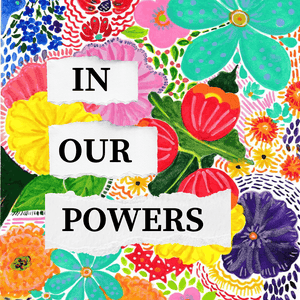
Sobre In Our Powers: The Holistic Self-defense Podcast
Welcome to In Our Powers: The Holistic Self-defense Podcast.
I'm Carolyn, a trauma-informed, holistic self-defense coach. If you've ever felt unsafe, struggled to trust your instincts, or wondered how to respond in a threatening situation, you're not alone.
On this show, we explore a broader definition of self-defense, one that goes beyond physical confrontation and includes all the ways we honor, protect, and advocate for ourselves.
Through conversations, stories, and practical insights, we talk about fear, self-trust, healthy relationships, boundaries, personal safety, and what it means to reclaim our power to respond. Together, we practice moving through fear, building confidence in our powers, and strengthening safety from within.
Because self-defense isn’t just about throwing strikes and kicks in a moment of danger.
It’s about building trust and safety from within.
I'm glad you're here.
Sítio Web de podcastOuve In Our Powers: The Holistic Self-defense Podcast, Flow Podcast e muitos outros podcasts de todo o mundo com a aplicação radio.pt
Obtenha a aplicação gratuita radio.pt
- Guardar rádios e podcasts favoritos
- Transmissão via Wi-Fi ou Bluetooth
- Carplay & Android Audo compatìvel
- E ainda mais funções
Obtenha a aplicação gratuita radio.pt
- Guardar rádios e podcasts favoritos
- Transmissão via Wi-Fi ou Bluetooth
- Carplay & Android Audo compatìvel
- E ainda mais funções

In Our Powers: The Holistic Self-defense Podcast
Leia o código,
descarregue a aplicação,
ouça.
descarregue a aplicação,
ouça.
 Portugal

