

Ouve este podcast gratuitamente na aplicação: Descarrega gratuitamente na App Store
radio.pt
Sleeptimer
Guardar rádio
153 episódios
Top Economist: NEW "Tax The Rich" Rule Will Change The US Economy Forever
15/07/2026 | 22min👉 Learn 50+ years of economics in only 7 weeks: https://www.skool.com/stevekeen
📚 Download my 3-Book Rebel Economist Bundle (Free this week here): https://www.stevekeen.com
--------------- 👉 Learn 50+ years of economics in only 7 weeks: https://www.skool.com/stevekeen
Download my 3-Book Rebel Economist Bundle (Free this week here): https://www.stevekeen.com
Is a billionaire tax actually the solution for California's economic issues? Economist Steve Keen breaks down why this policy misses the mark.
This analysis examines the proposed billionaire tax in California and critiques its effectiveness as a tool for economic reform. By reviewing the actual financial flows and existing tax structures, the video explains why policymakers might be targeting the wrong metrics. If you are interested in how economic policy impacts the broader financial system, this breakdown provides a clear look at the structural realities behind these proposals.
We also look at the decline of worker income share and why current strategies often fail to address the root causes of wealth disparity. Steve Keen uses charts and diagrams to illustrate how capital accumulation functions differently than many assume. Understanding these mechanisms is essential for anyone following debates on fiscal policy and economic inequality.
Subscribe for weekly economic policy breakdowns, and comment below with your thoughts on whether a wealth tax is a viable solution for the current economic climate.
Can federal spending actually unite California? Learn why current economic policy models might be based on outdated accounting.
This video examines the disconnect between public perception of federal debt and the actual mechanics of government finance. If you are interested in how California could bridge the gap between billionaires and the working class, this breakdown clarifies the core argument presented. We look at the specific proposal suggesting that union organizing and a shift in fiscal strategy could resolve long-standing economic tensions.
By challenging the standard economic textbooks that define modern political discourse, this analysis offers a fresh perspective on why we worry about the national debt. You will understand why the current framing of federal spending is often criticized as a false model and what that means for future economic policy. We focus on the practical implications of changing these accounting methods rather than just the political rhetoric.
Subscribe for weekly economic policy breakdowns and comment below on which financial theory you want us to explain next.
----
👉 Download my 3-Book Rebel Economist Bundle (Free this week here): https://www.stevekeen.com
----
#USEconomy #SteveKeen #BritainCrisis #EconomicCollapse #Neoliberalism #UKPolitics #DebtCrisis #LabourParty #StarmerResignationWhat Happens to Your Debt if the Dollar Collapses: Top Economist
14/07/2026 | 21min👉 Learn 50+ years of economics in only 7 weeks: https://www.skool.com/stevekeen
📚 Download my 3-Book Rebel Economist Bundle (Free this week here): https://www.stevekeen.com
--------------- 👉 Learn 50+ years of economics in only 7 weeks: https://www.skool.com/stevekeen
Download my 3-Book Rebel Economist Bundle (Free this week here): https://www.stevekeen.com
What if everything you've been told about the national debt is wrong?
A top economist sits down with a Government Accountability Office report warning Congress of an imminent debt crisis and systematically dismantles it. Using double-entry bookkeeping and live simulations, he reveals that government deficits don't "crowd out" the private sector they create money. The real threat isn't the $39.4 trillion national debt. It's the private debt sitting on household balance sheets, crushing the velocity of money and dragging GDP down with it. This is the argument the mainstream doesn't want you to hear.
✅ How government deficits actually create money not destroy it
✅ Why the GAO and CBO are using a 19th-century model of banking
✅ The double-entry bookkeeping truth banks don't advertise
✅ Why reducing private debt is more urgent than cutting government spending
✅ What happens to your mortgage, savings, and purchasing power if the dollar collapses
✅ The velocity of money crisis no one is talking about
Top economist Steve Keen warns that the U.S. debt crisis headlines are pointing at the wrong target.Government debt is a symptom private debt is the disease. The dollar collapse scenario everyone fears won't come from the national debt ceiling. It will come from a private debt deflation that mainstream economists, the Federal Reserve, and the GAO continue to ignore. If you're searching for financial education, economic analysis, or simply trying to understand what causes a fiat currency collapse, this breakdown of private debt vs public debt, velocity of money, and real money creation is essential viewing before the next recession hits.
----
👉 Download my 3-Book Rebel Economist Bundle (Free this week here): https://www.stevekeen.com
----
#USEconomy #SteveKeen #BritainCrisis #EconomicCollapse #Neoliberalism #UKPolitics #DebtCrisis #LabourParty #StarmerResignationThe Real Reason Governments Can’t Just Print More Money: Top Economist
09/07/2026 | 27min👉 Download my 3-Book Rebel Economist Bundle (Free this week here): https://www.stevekeen.com
Why do mainstream economics models fail to predict financial crises? Economist Steve Keen explains the ignored role of private debt.
Mainstream economics often overlooks the mechanics of how banks create money, leading to a fundamental misunderstanding of our financial system. This discussion breaks down why conventional models fail to account for the massive impact of private debt on our economy. If you have ever questioned why standard forecasts miss the mark during market downturns, this analysis provides the missing context.
Steve Keen argues that private debt acts as the primary engine behind economic booms and busts, rather than government spending or interest rates alone. By examining the reality of credit creation, you will gain a clearer picture of what actually drives financial instability. We also address common misconceptions surrounding government debt and how it functions compared to private lending.
Subscribe for weekly economic theory breakdowns, and comment below with your thoughts on whether private debt or government policy is the bigger risk to the economy.
Who is Dr. Steve Keen?
Dr. Steve Keen is an influential economist who has dedicated over 50 years to challenging mainstream economic theories. Since his days as a university student, he has been engaged in a David vs. Goliath battle against conventional economic models. Holding a Ph.D. in economics, Dr. Keen is well-known for his critical analysis and advocacy for more realistic economic approaches. His work emphasizes the importance of accounting for financial instability and incorporates elements of complex systems theory. Curious Minds, Engineers, and Finance Professionals will appreciate his methodical breakdown of economic phenomena and his development of the Minsky software, which models financial crises. Dr. Keen's contributions are crucial for anyone seeking a deeper understanding of how economic systems can impact technological and financial environments. His teachings offer valuable insights into the economic forces shaping our world. By following his analysis, professionals can gain a better grasp of economic dynamics that influence their fields.
----
👉 Download my 3-Book Rebel Economist Bundle (Free this week here): https://www.stevekeen.com
----
#usinflation #stevekeen #newworldorder #financialcrash #oilprices #Famine2026 #economiccollapse #trumpiran #irannuclear #energymarkets #chinaeconomyThe New Fed Chair's Plan to Cancel $39T Debt Crisis: Top Economist
08/07/2026 | 10min👉 Download my 3-Book Rebel Economist Bundle (Free this week here): https://www.stevekeen.com
In 2026, Kevin Warsh steps into the most powerful economic role on earth Federal Reserve Chairman inheriting America's staggering $39 trillion debt. World-renowned economist Steve Keen, who famously predicted the 2008 global financial crisis, delivers a sobering warning: Warsh is "cut from the same cloth" as every Fed chair before him. Trained in neoclassical economics a discipline Keen argues is built on fantasies that completely ignore money, banks, and private debt Warsh won't bring the radical change America desperately needs. Meanwhile, Trump's military escalation in the Strait of Hormuz has triggered a supply shock that conventional economists are misdiagnosing as demand-driven inflation. By raising interest rates to fight the wrong enemy, the Fed is accelerating bankruptcies, crushing the private sector, and destabilizing the very economy it claims to protect. Keen's verdict? 2026 is the year of chaos a financial crisis born not of market forces, but of human ignorance.
Why did Trump pick Kevin Warsh as the next Federal Reserve Chairman and what happens when Warsh inevitably disappoints him? How could a Strait of Hormuz blockade disrupt global fertilizer, helium, and sulfuric acid supplies and trigger a worldwide food crisis? Why does Steve Keen argue that raising interest rates during a supply shock actually causes more bankruptcies, not less inflation? What is neoclassical economics hiding and how do its "fantasy models" that ignore private debt make every financial crisis worse? Will Trump turn on his own hand-picked Fed chair the same way he turned on Jerome Powell? What role will the biggest El Niño in history play in the economic collapse of 2026?
In this in-depth economic analysis, top economist Steve Keen breaks down why the new Federal Reserve Chairman Kevin Warsh cannot solve the United States' spiraling $39 trillion debt crisis. As the Iran war escalates and the Strait of Hormuz blockade threatens global oil prices and supply chains, conventional economic policy, driven by flawed neoclassical economics, continues raising interest rates despite clear evidence this is a supply shock, not demand-driven inflation. Keen warns that Trump's Federal Reserve appointment will fail to prevent the coming global economic crisis, as private debt burdens crush American households and firms. With El Niño's economic impact compounding the destruction of productive capacity, 2026 is shaping up to be a year of unprecedented financial chaos.
00:00 — Kevin Warsh: The New Federal Reserve Chairman
01:15 — Meet Steve Keen: The Economist Who Predicted the 2008 GFC
02:30 — Why 2026 Is "The Year of Chaos"
03:30 — Neoclassical Economics: A Fantasy World That Ignores Money & Debt
04:30 — Why Warsh Is "Cut from the Same Cloth" as Every Fed Chair Before Him
05:30 — Supply Shock vs. Demand Shock: The Fed Is Fighting the Wrong War
06:30 — Strait of Hormuz: Fertilizer, Helium & Sulfuric Acid — The Hidden Supply Chain
07:30 — How Interest Rate Hikes Actually Cause More Bankruptcies
08:30 — Trump Will Turn on Warsh It's Only a Matter of Time
09:30 — 2026: A Financial Crisis Caused Purely by Human Ignorance
----
👉 Download my 3-Book Rebel Economist Bundle (Free this week here): https://www.stevekeen.com
----
#usinflation #stevekeen #newworldorder #financialcrash #oilprices #Famine2026 #economiccollapse #trumpiran #irannuclear #energymarkets #chinaeconomyThe Real Reason Why Keir Starmer Has Resigned: Top Economist
07/07/2026 | 18min👉 Download my 3-Book Rebel Economist Bundle (Free this week here): https://www.stevekeen.com
When Keir Starmer walked into Downing Street two years ago, he promised to fix what was broken. Instead, he became the latest prime minister crushed by forces far bigger than one man's leadership. In this video, top economist Steve Keen the man who predicted the 2008 Global Financial Crisis explains why Starmer's resignation isn't a personal failure. It's the inevitable result of 40 years of neoliberal economic policy that has trebled UK private debt, collapsed the velocity of money to just 1.2 times per year, and redistributed wealth from the working class to asset owners. Britain's economy hasn't just slowed it's been hollowed out, and no prime minister, not Starmer, not Cameron, not whoever comes next, can fix it without a fundamental shift in economic thinking.
Why did Keir Starmer really resign? What happened to Britain's 4% per capita growth rate and why did it fall to just 1.8% under neoliberalism? How did UK private debt explode from under 60% of GDP to 180% in a single generation? What does the cyclically adjusted price-to-earnings ratio hitting 40 above 1929 crash levels signal about the next financial crisis? And why does Steve Keen argue that politicians keep applying the same failed policies, decade after decade, despite the data showing catastrophic results for the physical economy? If you've been asking what comes next for Britain after Starmer, this analysis answers the question no mainstream news coverage will touch.
Key Themes:
✅ Starmer's resignation as a symptom of systemic neoliberal failure, not personal incompetence
✅ UK private debt tripled from under 60% to 180% of GDP between 1980 and the GFC
✅ Per capita growth collapsed from 4% to 1.8% under neoliberal policy
✅ Velocity of money declined from 2.2x to 1.2x, the hidden engine of economic stagnation
✅ CAPE ratio at 40 signals a stock market more overvalued than before the 1929 crash
✅ Why conventional economics textbooks keep producing politicians who repeat the same failures
Who is Dr. Steve Keen?
Dr. Steve Keen is an influential economist who has dedicated over 50 years to challenging mainstream economic theories. Since his days as a university student, he has been engaged in a David vs. Goliath battle against conventional economic models. Holding a Ph.D. in economics, Dr. Keen is well-known for his critical analysis and advocacy for more realistic economic approaches. His work emphasizes the importance of accounting for financial instability and incorporates elements of complex systems theory. Curious Minds, Engineers, and Finance Professionals will appreciate his methodical breakdown of economic phenomena and his development of the Minsky software, which models financial crises. Dr. Keen's contributions are crucial for anyone seeking a deeper understanding of how economic systems can impact technological and financial environments. His teachings offer valuable insights into the economic forces shaping our world. By following his analysis, professionals can gain a better grasp of economic dynamics that influence their fields.
----
👉 Download my 3-Book Rebel Economist Bundle (Free this week here): https://www.stevekeen.com
----
#KeirStarmer #UKEconomy #SteveKeen #BritainCrisis #EconomicCollapse #Neoliberalism #UKPolitics #DebtCrisis #LabourParty #StarmerResignation
Mais podcasts de Ciência
 UnexplainableCiência, Ciências da Vida
 The Rest Is ScienceCiência, Filosofia, Física, Sociedade e cultura, Tecnologia
 StarTalk RadioCiência, Ensino
 Inteligência Emocional • O PodcastCiência, Ciências Sociais
 The Joy of WhyCiência, Ciências da Vida
 Making Sense with Sam HarrisCiência, Filosofia, Notícias, Política, Religião, Religião e espiritualidades, Sociedade e cultura
 Mais lento do que a luzCiência
 RadiolabCiência, Ciências Naturais, Documentário, História, Sociedade e cultura
 E o Resto é... CiênciaCiência, Ciências da Terra
 Fricção CientíficaCiência, Sociedade e cultura
Podcasts em tendência em Ciência
 Let's Rock - Um podcast da Idade da PedraCiência
 You Are Not So SmartCiência, Ciências Sociais, Ensino, Sociedade e cultura
 RadiowissenCiência
 Espacio en blancoCiência
 Live Like a Girl with Dr. Mindy PelzCiência, Nutrição, Saúde alternativa, Saúde e fitness
 NaruhodoCiência, Ciências Sociais, Ciências da Vida, Enriquecimento individual, Ensino
 Aha! Zehn Minuten Alltags-WissenCiência, Ensino, Saúde e fitness
 Science QuicklyCiência
 Dr Karl PodcastCiência
 Science FridayCiência, Ciências Naturais, Ciências da Terra, Ciências da Vida
 Podcast Liberta-teCiência, Natureza
 TheThinkingAtheistCiência, Ensino, Sociedade e cultura
 EmonthebrainCiência
 Do ZeroCiência, Ciências Sociais
 New Books in PsychoanalysisCiência
 Sasquatch ChroniclesCiência, Ciências Naturais, Sociedade e cultura
 Real Organic PodcastCiência, Ciências da Terra, Negócios, Nutrição, Saúde e fitness, Sem fins lucrativos
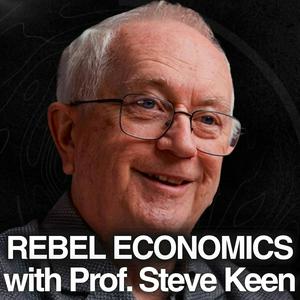
Sobre Rebel Economics with Professor Steve Keen
📚 Learn 50+ years of Real Economics in only 7 weeks. Apply here:
https://www.stevekeen.com
(Apply this week and get my 3-Book 'Rebel Economist' Bundle as a Free Bonus. Plus if you're fully approved by my team, get Ravel© - my proprietary economic visualization software I use in my YouTube videos; to predict the economy, like I did years before the 2008 Financial Crash happened).
--- Want to predict the future too? You're in good company: Trusted by thousands of engineers, finance professionals, and investors. Seen by tens of millions. ---
Professor Steve Keen's Ravel© framework called the 2008 financial crisis 36 months before Lehman. The IMF was calling soft landing. In 2010, the Revere Prize that followed had 1,152 votes from 2,500+ economists. More than twice Roubini and Baker combined.
This is Rebel Economics with Professor Steve Keen. The same patented Ravel© framework now runs for ministries of finance, central bank advisors, and sovereign wealth funds. Stock-flow consistent. Built on accounting identities, not equilibrium ideology. The math the IMF still does not have in its textbook.
Steve has been invited by BBC HARDtalk, Diary of a CEO, the European Parliament, Bloomberg, MIT's Lex Fridman, Piers Morgan Uncensored, ABC News Australia, amongst many more we cannot disclose now. 20M+ views, watched by policy teams and institutional allocators as a primer on debt-driven instability.
You are not crazy. The equations were wrong.
📚 Learn 50+ years of Real Economics in only 7 weeks. Apply here:
https://www.stevekeen.com
(Apply this week and get my 3-Book 'Rebel Economist' Bundle as a Free Bonus. Plus if you're fully approved by my team, get Ravel© - my proprietary economic visualization software I use in my YouTube videos; to predict the economy, like I did years before the 2008 Financial Crash happened).
Sítio Web de podcastOuve Rebel Economics with Professor Steve Keen, Unexplainable e muitos outros podcasts de todo o mundo com a aplicação radio.pt
Obtenha a aplicação gratuita radio.pt
- Guardar rádios e podcasts favoritos
- Transmissão via Wi-Fi ou Bluetooth
- Carplay & Android Audo compatìvel
- E ainda mais funções
Obtenha a aplicação gratuita radio.pt
- Guardar rádios e podcasts favoritos
- Transmissão via Wi-Fi ou Bluetooth
- Carplay & Android Audo compatìvel
- E ainda mais funções

Rebel Economics with Professor Steve Keen
Leia o código,
descarregue a aplicação,
ouça.
descarregue a aplicação,
ouça.
Rebel Economics with Professor Steve Keen: Podcast do grupo
 Portugal