
Ouve este podcast gratuitamente na aplicação: Descarrega gratuitamente na App Store
radio.pt
Sleeptimer
Guardar rádio
The Growth Time Machine with Daniel Curtis
Daniel Curtis
Último episódio
69 episódios
Jack the Ripper: The Truth Behind the Myths | Metropolitan Police Museum Curator Doctor Clare Smith
13/11/2026 | 1h 35minJack the Ripper remains one of history's most notorious unidentified serial killers. But how much of what we think we know about the Whitechapel murders of 1888 comes from historical evidence, and how much was invented by Hollywood?In this episode of The Growth Time Machine, Daniel Curtis is joined by Dr Clare Smith, Historic Collection Curator at the Metropolitan Police Museum, whose PhD research examined the depiction of Jack the Ripper in film and popular culture.From Johnny Depp in From Hell and Michael Caine in Jack the Ripper (1988) to Sherlock Holmes in Murder by Decree, we explore how cinema transformed an unidentified Victorian murderer into one of the most recognisable figures in criminal history.Why the top hat, black cape and Gladstone bag? Why are the streets of Whitechapel always covered in fog? And why do so many films portray Jack the Ripper as an aristocrat, surgeon or member of a royal conspiracy when the historical evidence tells a very different story?Drawing on her research into Jack the Ripper films, Victorian London, crime history and the psychology of murder, Clare examines the extraordinary influence of cinema on our understanding of real criminal investigations.We discuss Alfred Hitchcock's The Lodger: A Story of the London Fog, From Hell (2001), Murder by Decree, the Michael Caine television drama Jack the Ripper (1988), A Study in Terror (1965), Hands of the Ripper (1971), Dr. Jekyll and Sister Hyde (1971), Room to Let (1950) and other adaptations that have helped shape the Ripper legend.But this conversation goes well beyond the movies.We examine the real Jack the Ripper investigation, the Metropolitan Police and Scotland Yard in 1888, Inspector Frederick Abberline, Commissioner Charles Warren, the Whitechapel murders, Mitre Square, Buck's Row, the Thames Torso Murders and the extraordinary difficulties facing Victorian detectives.We also discuss Jack the Ripper suspects, including Aaron Kosminski, Charles Lechmere, Francis Tumblety, Sir William Gull and Walter Sickert, and consider whether the murderer may simply have been an otherwise unremarkable local man.Our discussion explores the victims of the Whitechapel murders, including Mary Ann Nichols, Annie Chapman, Elizabeth Stride, Catherine Eddowes and Mary Jane Kelly, alongside other possible victims and the limitations of the traditional Canonical Five.Why have the women so often been reduced to supporting characters in films about their own murders? And what responsibility do historians, filmmakers and true crime creators have to the victims and their families?The conversation also moves into some of Britain's most disturbing real murder cases and the history of serial killing.We discuss Peter Sutcliffe and the Yorkshire Ripper investigation, the ITV television drama The Long Shadow (2023), the Moors Murders involving Ian Brady and Myra Hindley, Fred and Rose West, Ian Huntley and the Soham murders, Dr Harold Shipman, Dennis Nilsen, John George Haigh, George Joseph Smith, Neville Heath and John Christie.Across the Atlantic, our discussion touches on the Zodiac Killer, Arthur Leigh Allen, Dennis Rader (BTK), Ted Bundy, Charles Manson, Joseph James DeAngelo (the Golden State Killer) and O. J. Simpson.We consider why serial killers become famous, how the media gives murderers their identities, the appeal of true crime, and why fictional characters such as Hannibal Lecter can influence public perceptions of real offenders.Clare also provides a fascinating insight into the Metropolitan Police Museum and Crime Museum collections, the preservation of historical criminal evidence, forensic investigation and the ethical challenges of displaying objects associated with murder.Was Francis Tumblety Jack the Ripper? A Disturbing Trail of Evidence | Michael L. Hawley
11/11/2026 | 1h 25minWas Francis Tumblety Jack the Ripper? In 1888, as the Whitechapel murders terrorised Victorian London, an extraordinary American medical practitioner came under suspicion. His name was Dr Francis Tumblety.But was Francis Tumblety genuinely one of the most compelling Jack the Ripper suspects, or has his connection to the Whitechapel murders been exaggerated over more than a century?In this episode of The Growth Time Machine, Daniel Curtis is joined by Michael L. Hawley, historian, author and one of the leading researchers investigating Francis Tumblety's extraordinary life and possible connection to Jack the Ripper.Drawing upon years of archival investigation, contemporary newspaper reports, court proceedings and previously overlooked historical records, Michael examines evidence that challenges much of what we think we know about the notorious American.Who was Francis Tumblety?A flamboyant, wealthy, self-promoting nineteenth-century medical practitioner, Tumblety travelled extensively between America, Canada and Britain. He claimed medical expertise, cultivated an extraordinary public persona and became entangled in controversies ranging from questionable medical practices to the investigation following Abraham Lincoln's assassination.But behind the eccentricity lay a far more complicated individual.*In this detailed Jack the Ripper investigation, we explore:*
Who Francis Tumblety really was, and how he built his extraordinary reputation.
Whether Tumblety possessed genuine medical and anatomical knowledge.
The disturbing historical allegations concerning his interest in human organs and anatomical specimens.
His surprising connection to the aftermath of Abraham Lincoln's assassination.
Why Scotland Yard considered Francis Tumblety a suspect in the Whitechapel murders.
The significance of Chief Inspector John Littlechild's letter.
Michael Hawley's archival discoveries concerning Tumblety's life, behaviour and movements.
The competing claims surrounding photographs supposedly showing the real Francis Tumblety.
Tumblety's arrest in London in November 1888 and the crucial question of his custody status.
Whether Tumblety could have been at liberty when Mary Jane Kelly was murdered on 9 November 1888.
His departure from Britain and the subsequent interest in him.
Whether the evidence supports the theory that Francis Tumblety was Jack the Ripper.
We also explore the wider question of criminal psychology, personality, deception, narcissism and the dangers of attempting to establish guilt through behavioural interpretation alone.Michael L. Hawley's books and researchMichael has written extensively about Francis Tumblety, the Whitechapel murders and nineteenth-century violent crime. His publications include:Jack the Ripper Suspect Dr. Francis TumbletyThe Ripper's HauntsDr. Francis Tumblety & The Railway RipperHis research has also appeared in specialist historical publications, including Ripperologist and the *Whitechapel Society Journal*.Explore Michael's work:Official website:https://michaellhawley.com/Books:https://michaellhawley.com/my-booksPublished research articles:https://michaellhawley.com/articlesDr. Francis Tumblety & The Railway Ripper.https://www.sunburypress.com/collecti...#JackTheRipper #FrancisTumblety #MichaelLHawley #WhitechapelMurders #JackTheRipperSuspects #TrueCrime #VictorianLondon #CriminalHistory #UnsolvedMysteries #TheGrowthTimeMachineThe Secret: How Brian Zinn Solved Cleveland's Treasure Mystery | 9 Still Undiscovered After 44 Years
09/11/2026 | 1h 8minIn 1982, Byron Preiss launched one of the most extraordinary real-life treasure hunts ever created: The Secret: A Treasure Hunt. Forty-four years later, just THREE of the twelve hidden treasures have been recovered. Nine remain undiscovered. But are they still out there?In this episode of The Growth Time Machine, Daniel Curtis is joined by Brian Zinn, the man who helped solve the Cleveland treasure mystery in 2004, uncovering one of the legendary ceramic casques hidden by Byron Preiss more than two decades earlier.Alongside fellow treasure hunter Andy Abrams, Brian discovered the Cleveland casque in the Greek Cultural Garden in Rockefeller Park, Ohio, after following the cryptic clues contained in The Secret.Now, Brian shares the story of his remarkable treasure hunt, the clues that led to Cleveland, and the lessons that could help today's treasure hunters searching for the nine remaining casques.THE SECRET: 12 TREASURES, 3 FOUND, 9 STILL MISSINGPublished in 1982, The Secret combined twelve mysterious paintings by fantasy artist John Jude Palencar with twelve cryptic verses. Each image and verse concealed clues to a hidden treasure somewhere in North America.Only three confirmed discoveries have been made:🏺 Chicago, Illinois (1983) – The first casque recovered.🏺 Cleveland, Ohio (2004) – Brian Zinn and Andy Abrams solve the Cleveland mystery.🏺 Boston, Massachusetts (2019)– The third casque is recovered.As of 2026, nine treasures remain unrecovered, and their precise locations are still a mystery.IN THIS EPISODE🔹 How Brian Zinn became involved in *The Secret* treasure hunt.🔹 How he deciphered the Cleveland painting and Verse 4.🔹 The clues hidden within Cleveland's Cultural Gardens.🔹 The remarkable story behind the discovery of the Cleveland casque.🔹 Why solving the mystery took more than twenty years.🔹 What the Cleveland discovery reveals about Byron Preiss's puzzles.🔹 The challenges facing modern treasure hunters.🔹 Whether the remaining nine casques could still be discovered.🔹 Advice and insights from someone who successfully solved one of the original puzzles.CAN THE NINE REMAINING TREASURES STILL BE FOUND?From San Francisco and New York to Charleston, Milwaukee, Houston and Montreal, treasure hunters continue to investigate the unsolved puzzles.But after 44 years of changing landscapes, redeveloped parks and countless competing theories, an extraordinary question remains: are the treasures still buried somewhere, or have some been lost forever?Brian Zinn is one of the few people who can speak from firsthand experience about successfully solving The Secret.Whether you're a lifelong treasure hunter, a fan of Byron Preiss, or someone discovering the mystery for the first time, this conversation offers a fascinating look at one of the world's most enduring treasure hunts.EXPLORE THE SECRET TREASURE HUNTThe Secret: A Treasure Hunt – Community research, paintings, verses and discoveries:https://12treasures.com/Cleveland casque – History, clues and research:https://12treasures.com/cleveland/History of The Secret – Including the Cleveland discovery:https://12treasures.com/history-of-the-secret/The Secret – 2026 treasure recovery status:https://treasureamongus.com/page/hunts/other/the_secret/solve_statusABOUT THE GROWTH TIME MACHINEHosted by Daniel Curtis, The Growth Time Machine explores extraordinary true stories, historical mysteries, unsolved crimes, remarkable discoveries and the people who have experienced them firsthand.From Jack the Ripper and D.B. Cooper to lost treasures and extraordinary survival stories, we go beyond the headlines to speak with the people who know these stories best.Subscribe for more fascinating interviews, real-life mysteries and historical investigations.#TheSecret #BrianZinn #TreasureHunt #ByronPreiss #HiddenTreasure #UnsolvedMysteries #ClevelandCasque #TreasureHunting #TheGrowthTimeMachineThe Thames Torso Murders: What the River Reveals | Dr Hannah Stockton, Royal Museums Greenwich
07/11/2026 | 42minWhat secrets could the River Thames hold about one of Victorian London's most disturbing unsolved mysteries?In the late 1880s, as Jack the Ripper terrorised the streets of Whitechapel, another series of horrifying discoveries was taking place along the River Thames. Human remains, sometimes separated by considerable distances, were found in and around the river, raising questions that remain unanswered nearly 140 years later.But to understand the Thames Torso Murders, we must first understand the river itself.In this episode of The Growth Time Machine, Daniel Curtis is joined by Dr Hannah Stockton, Curator of Maritime London and Merchant Marine at Royal Museums Greenwich, home of the National Maritime Museum.A historian specialising in the Thames, its workers and maritime London, Hannah takes us back to a time when the Port of London was among the busiest in the world.Far from the river we recognise today, the Victorian Thames was a vast working environment filled with vessels, cargo, warehouses, landing stages and thousands of people whose livelihoods depended upon it.Could understanding this forgotten world change how we interpret the Thames Torso Murders?THE THAMES IN VICTORIAN LONDONThroughout this fascinating conversation, we explore:• What the Thames really looked like during the 1880s, when London's port was at the height of its global importance.• The lives of watermen, lightermen, dockworkers and the thousands of people working along the river.• How accessible the Thames was to ordinary Londoners, including its stairs, landing places and secluded areas.• Whether somebody transporting a substantial wrapped object would have attracted attention.• The reality of the Thames after dark, including river traffic, lighting, fog and opportunities to move unseen.• How tides, currents and the river's changing geography affected the movement of objects and human remains.• Why the discovery of remains at a particular location does not necessarily establish where they entered the water.• What maritime history can contribute to our understanding of the Thames Torso Murders and their possible relationship to the Jack the Ripper crimes.PRINCESS ALICE DISASTER OF 1878We also explore one of the most devastating but surprisingly forgotten tragedies in British maritime history.On 3 September 1878, the passenger steamer Princess Alice collided with the steamship Bywell Castle on the River Thames, resulting in the deaths of hundreds of people.Hannah discusses this catastrophe, what it reveals about the Victorian Thames and the extraordinary challenges surrounding the movement and recovery of bodies in the river.Her research into the disaster is also the subject of her book, *The Princess Alice Disaster: Tragedy on the Thames*, published by Royal Museums Greenwich. ABOUT DR HANNAH STOCKTONDr Hannah Stockton is Curator of Maritime London and Merchant Marine at Royal Museums Greenwich.. HANNAH'S BOOK AND FURTHER READINGThe Princess Alice Disaster: Tragedy on the ThamesBy Dr Hannah Stockton — Royal Museums GreenwichExplore the book here:https://shop.rmg.co.uk/collections/our-publications/products/spotlights-princess-aliceRoyal Museums Greenwich — Official Websitehttps://www.rmg.co.uk/Dr Hannah Stockton — Official Curator Profilehttps://www.rmg.co.uk/about-us/meet-curators-british-empire-tradeABOUT THE GROWTH TIME MACHINEHosted by Daniel Curtis, The Growth Time Machine explores history, true crime, unsolved mysteries and human behaviour through conversations with historians, academics, investigators and specialist researchers.This episode approaches the Thames Torso Murders through maritime history, examining the world in which these discoveries occurred rather than promoting any particular suspect or theory.Could the River Thames itself hold important clues to understanding these Victorian murders?Jack the Ripper: Could the Killer Have Been a Slaughterman? The Evidence | Professor Andrew Knight
05/11/2026 | 55minWas Jack the Ripper a surgeon, a doctor, or could the world's most infamous unidentified serial killer have been a slaughterman?
In 1888, a series of brutal murders terrorised London's East End. The killer's apparent ability to remove internal organs led many to believe he possessed medical or surgical training. But what if the evidence points towards an entirely different profession?In this episode of The Growth Time Machine, Daniel Curtis is joined by Professor Andrew Knight, veterinary surgeon, animal welfare researcher and Fellow of the Royal College of Veterinary Surgeons.
In 2017, Professor Knight and historian Dr Katherine Watson published a peer-reviewed academic paper examining whether Jack the Ripper could have worked in one of Victorian London's slaughterhouses.
Drawing on historical medical evidence, anatomical knowledge, surgical techniques, Victorian working conditions and research into human and animal violence, Professor Knight presents a fascinating alternative to the traditional image of the Ripper as a medically trained killer.
WHAT DO WE EXPLORE? The medical evidence from the Jack the Ripper murders, particularly Catherine Eddowes.• Why Professor Knight believes the abdominal incisions were inconsistent with conventional surgical training.• How difficult it would have been to locate and remove Eddowes's left kidney.• Whether a slaughterman could have developed the necessary anatomical knowledge through experience.• The prevalence of slaughterhouses in Victorian Whitechapel and their possible significance.• The type of knife used and what the wounds might reveal about the killer.• The controversial From Hell letter and whether its disputed authenticity affects the theory.• Research into animal cruelty, desensitisation and the relationship between violence towards animals and humans.• Whether the Victorian cat's-meat trade deserves further investigation.
At the heart of this discussion is a fundamental question: Does the evidence suggest Jack the Ripper possessed surgical knowledge, practical butchery experience, or something else entirely?
ABOUT PROFESSOR ANDREW KNIGHTProfessor Andrew Knight is a veterinary professor and internationally recognised animal welfare specialist. His research encompasses veterinary medicine, animal welfare, ethics and the relationship between human and animal violence.
His 2017 paper with Dr Katherine Watson, Was Jack the Ripper a Slaughterman? Human-Animal Violence and the World's Most Infamous Serial Killer, presents an interdisciplinary examination of one of history's greatest unsolved crimes.
ANDREW KNIGHT — LINKS & RESEARCH Official website:https://www.andrewknight.info/Jack the Ripper research:https://www.andrewknight.info/articles/jack-the-ripper/Original academic paper (2017):https://doi.org/10.3390/ani7040030Read the full paper free:https://pmc.ncbi.nlm.nih.gov/articles/PMC5406675/Biography and academic work:https://www.andrewknight.info/about/bio/Publications:https://www.andrewknight.info/news/publications/ABOUT
THE GROWTH TIME MACHINE Hosted by Daniel Curtis, The Growth Time Machine explores history, true crime, unsolved mysteries and human behaviour through in-depth conversations with leading researchers, historians, investigators and experts. The identity of Jack the Ripper remains unknown. This interview examines Professor Knight's published hypothesis, rather than presenting it as an established conclusion. What do you think? Could Jack the Ripper have been a slaughterman? Share your thoughts in the comments.
Subscribe for more evidence-led conversations exploring history's greatest mysteries.
#JackTheRipper #AndrewKnight #WhitechapelMurders #Ripperology #CatherineEddowes #VictorianLondon #TrueCrime #UnsolvedMysteries #TheGrowthTimeMachine
Mais podcasts de Enriquecimento individual








Podcasts em tendência em Enriquecimento individual















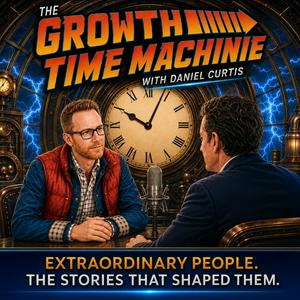
Sobre The Growth Time Machine with Daniel Curtis
The Growth Time Machine with Daniel Curtis brings you face to face with extraordinary people—and remarkable stories.
From those who witnessed history and survived the unimaginable to investigators pursuing the world’s enduring mysteries, these are conversations with people who lived it, studied it or stood closer than almost anyone else.
Daniel goes beyond the headlines to discover who his guests were, what shaped them and how extraordinary events changed their lives.
History. Mystery. Survival. Remarkable lives—told by the people who were there.
Sítio Web de podcastOuve The Growth Time Machine with Daniel Curtis, SOLVED with Mark Manson e muitos outros podcasts de todo o mundo com a aplicação radio.pt
Obtenha a aplicação gratuita radio.pt
- Guardar rádios e podcasts favoritos
- Transmissão via Wi-Fi ou Bluetooth
- Carplay & Android Audo compatìvel
- E ainda mais funções

The Growth Time Machine with Daniel Curtis: Podcast do grupo
 Portugal

