
Ouve este podcast gratuitamente na aplicação: Descarrega gratuitamente na App Store
radio.pt
Sleeptimer
Guardar rádio
182 episódios
Reflection
25/08/2026 | 55minAs Overthink comes to a close, why not take a look back? In Episode 182, Ellie and David tackle the concept of reflection and explain why it is so central to philosophy. What is the value of reflection, and what are its drawbacks? How does philosophy go astray when it treats the self as a product of reflection, and how can phenomenology and existentialism shed light on the proper role of reflection in our lives? Your hosts analyze the myth of Narcissus, discuss studies on reflection among animals such as rats and dolphins, and consider reflection as a visual metaphor for thinking. In the Substack bonus segment, Ellie and David reflect on Overthink and give some final thoughts before its end.
Works Discussed:
Ellie Anderson, Self-Relation: A Phenomenology of Ambiguity (forthcoming May 2027)
Hans-Johann Glock, “Do Animals Have Thoughts?”
Dieter Henrich, “Fichte’s Original Insight”
Maurice Merleau-Ponty, The Phenomenology of Perception
Gabriel Marcel, The Mystery of Being
Ovid, Metamorphosis
David Peña-Guzmán, When Animals Dream
JD Smith et al. “The uncertain response in the bottlenosed dolphin (Tursiops truncatus)”
Elevate your summer wardrobe. Go to Quince.com/overthink for free shipping on your order and 365-day returns. Now available in Canada, too.
If you’re ready to stop talking yourself out of finding care and making progress, then head to rula.com and take the first step.
See Privacy Policy at https://art19.com/privacy and California Privacy Notice at https://art19.com/privacy#do-not-sell-my-info.Mourning
11/08/2026 | 59minNothing can devastate us more than the loss of a loved one. In this episode of Overthink, David and Ellie talk about mourning. What kinds of losses hurl us into a state of mourning? Are there healthy and unhealthy ways of mourning? Or does this distinction not apply in cases when we are dealing with irreparable loss? And how do we deal with the loss of someone when the feeling of loss doesn't naturally resolve but rather stays with us like “an open wound,” as Freud says? To shed light on this difficult experience, your hosts explore Sigmund Freud’s distinction between mourning and melancholia, Roland Barthes’ account of grieving the death of his mother, as well as Emilio Uranga’s analysis of the role that culture plays in our experience of death. In the Substack bonus segment, Ellie and David discuss how Freud’s notion of ambivalence can help to make sense of mourning.
Works Discussed:
Roland Barthes, Mourning Diary
Julie Alev Dilmaç, “The new forms of mourning: Loss and exhibition of the death on the internet”
Martin Heidegger, Being and Time
Corina Sas and Alina Coman, “Designing personal grief rituals: An analysis of symbolic objects and actions”
Sigmund Freud, “Mourning and Melancholia”
Emilio Uranga, “Dos teorias de la muerte: Sartre y Heidegger”
Emilio Uranga, “Notas para un estudio del mexicano”
Emilio Uranga, Analysis of Mexican Being
Elevate your summer wardrobe. Go to Quince.com/overthink for free shipping on your order and 365-day returns. Now available in Canada, too.
If you’re ready to stop talking yourself out of finding care and making progress, then head to rula.com and take the first step.
See Privacy Policy at https://art19.com/privacy and California Privacy Notice at https://art19.com/privacy#do-not-sell-my-info.Weddings
28/07/2026 | 59minSomething old, something new, something borrowed, something blue! In this episode, Ellie and David talk about weddings. What kind of celebration is a wedding? And what social function do these festivities serve? Do weddings necessarily legitimize the institution of marriage? Or can weddings be dissociated from this legal institution and its problematic history? As they ponder these issues, your hosts walk you down the aisle of history by considering how early Christians developed their views about weddings by embracing some aspects of Roman weddings while rejecting others as vain and contrary to virtue. They also explore the meaning of weddings symbols that are still with us today and look at how weddings can challenge exclusionary nationalist ideologies. In the Substack bonus segment, Ellie and David talk about the weddings they’ve been to and discuss historical factors that shape our current conception of weddings.
Works Discussed:
Stephanie Coontz, Marriage, a History
Laurie Essig, Love, Inc.
Arnold van Gennep, The Rites of Passage
Brooke Leany, “Something borrowed: The origins of Christian wedding rituals.”
Ellen Rothman, Hands and Hearts: A History of Courtship in America
Lisa Schwarzbaum, “Mamdani, His Mother and a Movie of Prescient Grace”
Jonathan Wolff, “The Value of Ceremonies”
Start your business today with the industry’s best business partner, Shopify. Sign up for your one-dollar-per-month trial today at shopify.com/overthink
Elevate your summer wardrobe. Go to Quince.com/overthink for free shipping on your order and 365-day returns. Now available in Canada, too.
If you’re ready to stop talking yourself out of finding care and making progress, then head to rula.com and take the first step.
See Privacy Policy at https://art19.com/privacy and California Privacy Notice at https://art19.com/privacy#do-not-sell-my-info.Unemployment
14/07/2026 | 55minAfter a BIG announcement (!!!), your hosts David and Ellie get into the economic and psychological features of the state no one wants to be stuck in: unemployment. How does capitalism structurally construct “wageless life” while nonetheless treating it as a personal failure or unhappy accident? What’s the connection between unemployment and reactionary politics? And is AI going to put us all out of a job? Correcting misconceptions about automation, UBI, and more, your hosts take you through some significant arguments about the impacts of unemployment and reflect on why this socially-constructed position can make us feel so worthless even when we know that we’re not the problem. In the Substack bonus segment, Ellie and David reflect on the end of Overthink and share some reasons for it.
Works Discussed:
Aaron Benanav, Automation and the Future of Work
Aaron Benanav, “Is the AI Bubble About to Burst?”
Eloundou et al., “GPTs are GPTs: An Early Look at the Labor Market Impact Potential of Large Language Models”
Charles Babbage, On the Economy of Machines and Manufactures
Michael Denning, “Wageless Life”
Wendy Brown, In the Ruins of Neoliberalism
Regina Bateson, “Perceptions of pandemic resume gaps: Survey experimental evidence from the United States”
Start your business today with the industry’s best business partner, Shopify. Sign up for your one-dollar-per-month trial today at shopify.com/overthink
Elevate your summer wardrobe. Go to Quince.com/overthink for free shipping on your order and 365-day returns. Now available in Canada, too.
If you’re ready to stop talking yourself out of finding care and making progress, then head to rula.com and take the first step.
See Privacy Policy at https://art19.com/privacy and California Privacy Notice at https://art19.com/privacy#do-not-sell-my-info.Beauty with Heather Widdows
30/06/2026 | 56minBeauty is big business, and the rise of looksmaxxing and increasingly invasive treatments is raising the alarm on the ways that our looks matter in our personal and social lives. Ellie and David speak with philosopher Heather Widdows about how the emphasis on beauty in the present day constitutes a real shift from previous eras. Beauty is no longer taken as a sign of moral goodness, but itself has become a moral ideal. This applies worldwide. The “beauty ideal” is seeping into practically every culture and coming to be expected of more and more people for longer periods of their lifespan. They touch on the four elements of the beauty ideal that Widdows identifies and reflect on their own beauty practices and what it means to be complicit in a toxic system. In the Substack bonus segment, they touch on Lacan, America’s Next Top Model, and image-based profiles.
Works Discussed:
Heather Widdows, Perfect Me: Beauty as an Ethical Ideal
Start your business today with the industry’s best business partner, Shopify. Sign up for your one-dollar-per-month trial today at shopify.com/overthink.
Elevate your summer wardrobe. Go to Quince.com/overthink for free shipping on your order and 365-day returns. Now available in Canada, too.
If you’re ready to stop talking yourself out of finding care and making progress, then head to rula.com and take the first step.
See Privacy Policy at https://art19.com/privacy and California Privacy Notice at https://art19.com/privacy#do-not-sell-my-info.
Mais podcasts de Ensino








Podcasts em tendência em Ensino



























Sobre Overthink
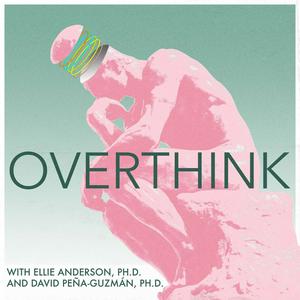
The best of all possible podcasts, Leibniz would say. Putting big ideas in dialogue with the everyday, Overthink offers accessible and fresh takes on philosophy from enthusiastic experts. Hosted by professors Ellie Anderson (Pomona College) and David M. Peña-Guzmán (San Francisco State University).
Sítio Web de podcastOuve Overthink, ̶N̶ã̶o̶ fica bem falar de... e muitos outros podcasts de todo o mundo com a aplicação radio.pt
Obtenha a aplicação gratuita radio.pt
- Guardar rádios e podcasts favoritos
- Transmissão via Wi-Fi ou Bluetooth
- Carplay & Android Audo compatìvel
- E ainda mais funções
Obtenha a aplicação gratuita radio.pt
- Guardar rádios e podcasts favoritos
- Transmissão via Wi-Fi ou Bluetooth
- Carplay & Android Audo compatìvel
- E ainda mais funções

Overthink
Leia o código,
descarregue a aplicação,
ouça.
descarregue a aplicação,
ouça.
 Portugal